|
|
|
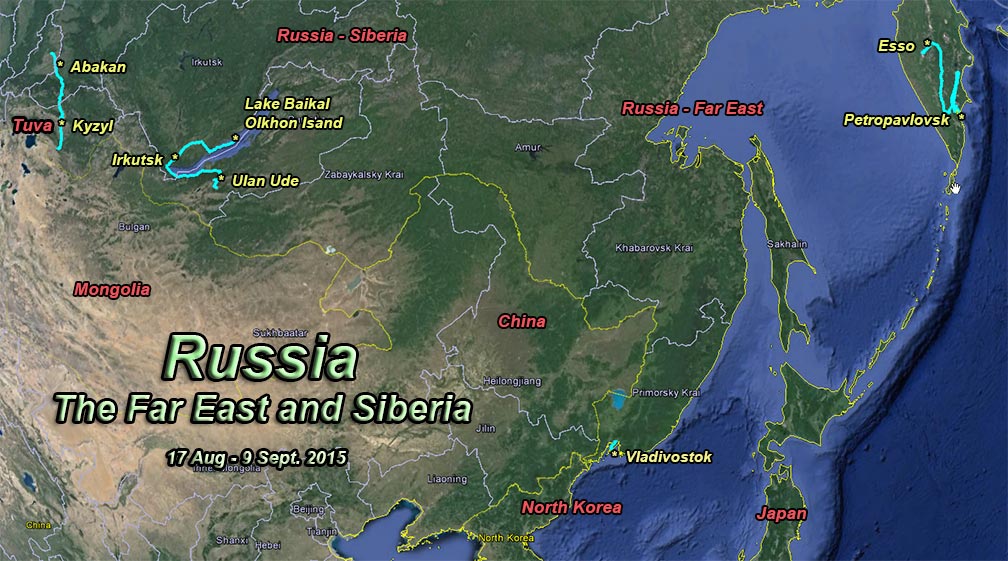
We wanted to go to Tuva (in southern
Siberia, just north of western Mongolia) for several reasons given later. As
long as we were going to Russia we decided to other visit other places we
thought would be interesting. We started in Vladivostok, just miles
north of North Korea. We thought it was in the far north, but it is at the
same latitude as Florence, Italy. It’s very cold in winter due to it being
influenced by the Siberian High. After Vladivostok, we flew NE to Kamchatka
to see the Geyser Valley, the volcanoes and a reindeer herd. From there, we flew SW to Irkutsk, which
is near the Mongolian border. From Irkutsk we stayed on Olkhon Island in the
middle of Lake Baikal, and also from Irkutsk we took an overnight on the
Siberian Express railway to Ulan Ude, where we toured the city and visited a
village of “Old Believers.” We then flew back to Irkutsk, continuing
on to Kyzyl, the capital of Tuva. The places we visited are printed in
yellow; the areas in red are to help place their locations. The turquoise
lines show our driving routes as well as our two helicopter flights in
Kamchatka and the train track from Irkutsk to Ulan Ude. |
|
|
|
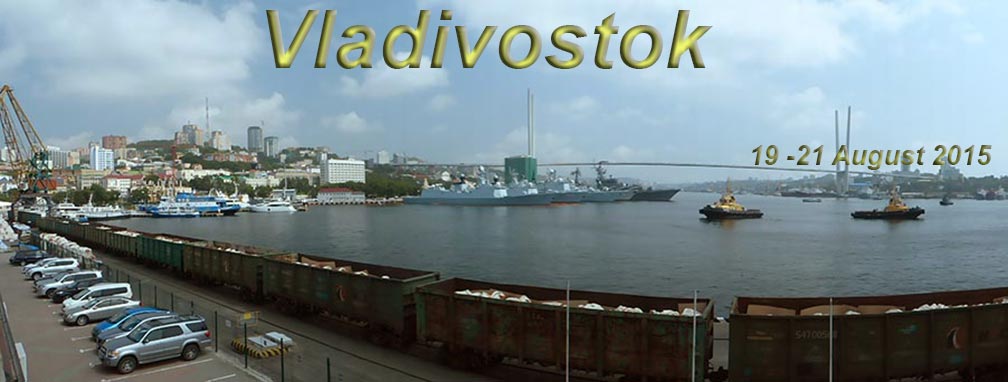
Vladivostok means “ruler
of the east” and is the home port of the Russian Pacific Fleet and the
largest Russian port on the Pacific Ocean. Due to its close
proximity to Japan, Japanese is the 2nd language of many
inhabitants. The locals consider their culture a fusion one as there is much
Asian influence. Thousands of used
Japanese cars arrive here to be sold throughout Siberia which leads to most
cars having the steering wheels on the “wrong side” as Russia drives on the
right. The population is around
600,000; the majority of which is ethnic Russians and Ukrainians. For the 35 years of the
Soviet Era (1958-1992) Vladivostok was off-limits to foreigners. |
|
|
|
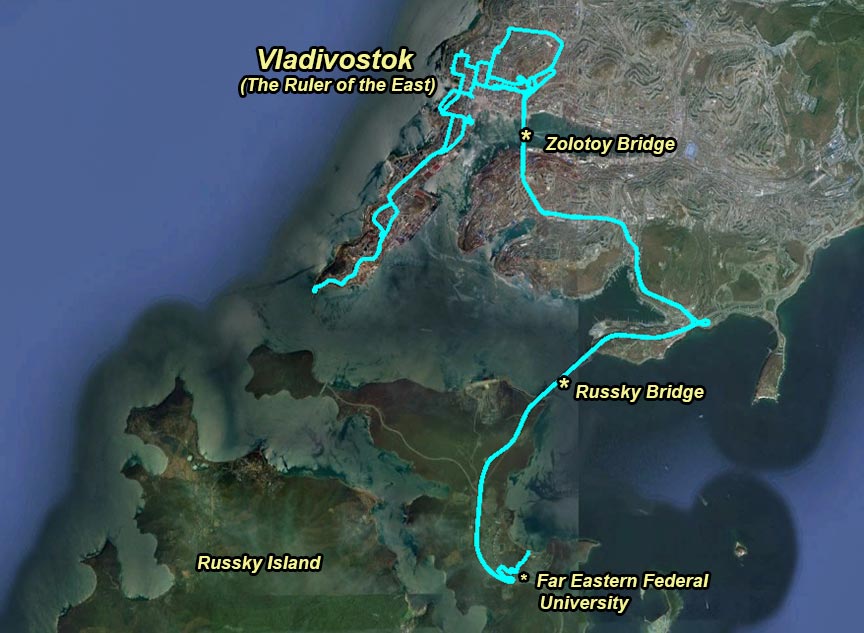
On the beautiful day we spent in Vladivostok we were almost
always in sight of water. All the pollution shown on this satellite map wasn’t
visible and people were swimming in the water. Local ecologists have claimed that many of the suburbs are
polluted and that living in them can be classified as a health hazard.
Vladivostok has about eighty industrial sites; the worst being shipbuilding
and repairing, power stations, printing, fur farming and mining. Among the worst affecting the water is the loading of coal
onto ships. The people complain but the companies causing the problems are
among the biggest and most powerful in Russia and cannot be touched by the
government. |
|
|
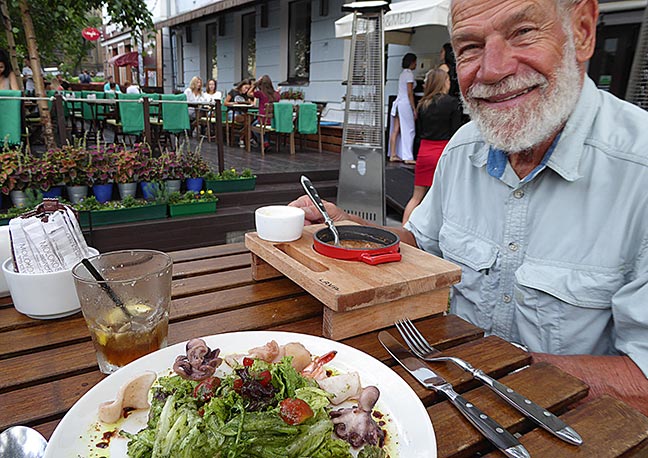
Our first lunch in Vladivostok was wonderful. Note the fusion: Juergen is having Russian borscht served in
Japanese style! Yvonne had the most amazing seafood salad: note the tiny octopus,
scallops, shrimp. Yum! |
|
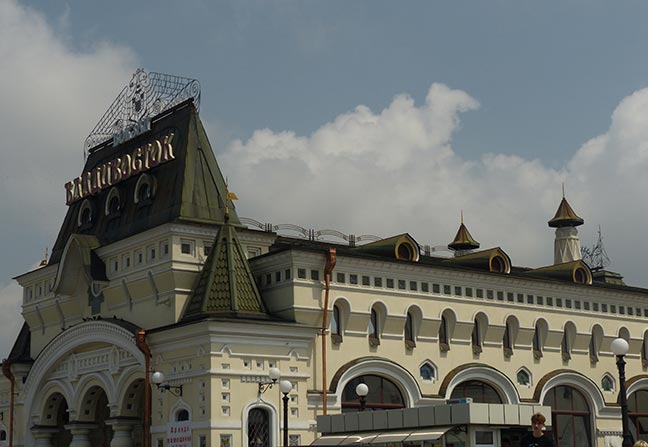
Vladivostok is the eastern terminus for the Trans-Siberian
railway; the western terminus is Moscow. The railway was completed in 1905. There are connecting branch lines into Mongolia, China and North
Korea along the route. Its length is 5,772 miles making it the longest railway line
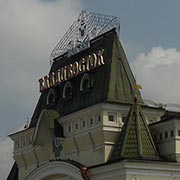
in the world. This train station is very attractive both outside and inside.
It was commissioned by the last Tsar and the communists pulled down all of
the decoration. It since has been restored to its original look. |
|
|
|
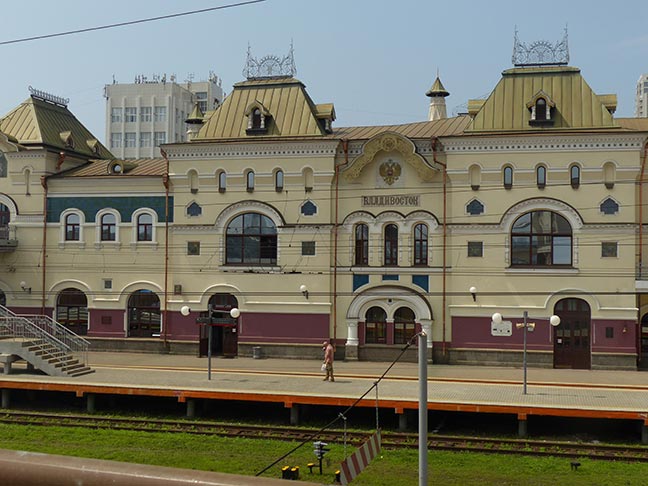
This is the view of the train station that faces the tracks. Sister cities for Vladivostok include San Diego! Yul Brynner was from here. |
|
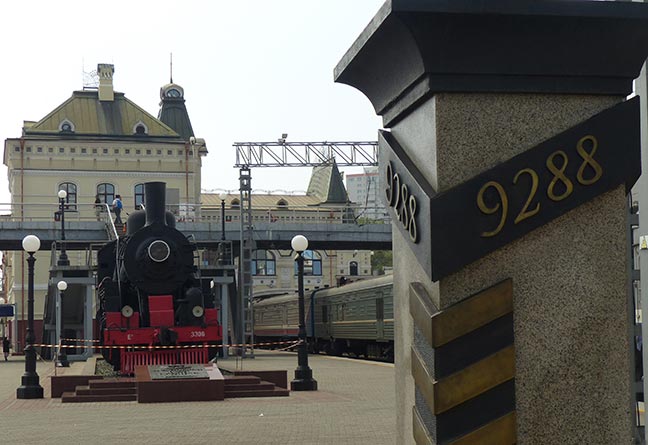
This is the kilometer marker for the length of the railway:
9288 km (5772 miles). There is a story behind that old train engine, but we couldn’t
reconstruct it after we got home. For some reason, the U.S. gave it to Russia during a war. |
|
|
|
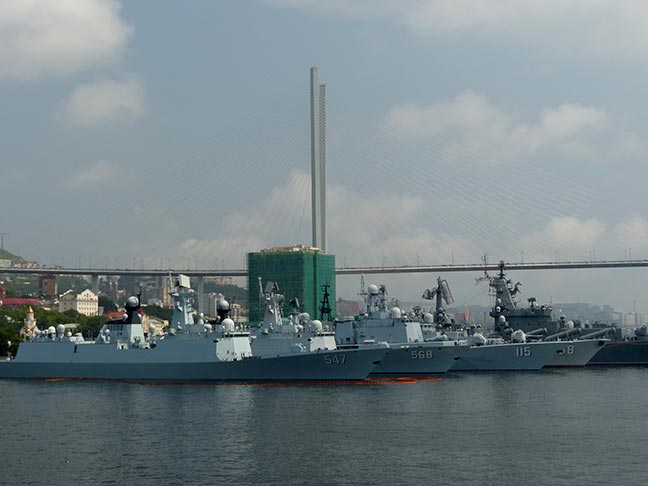
Since Vladivostok is home to the Russian Pacific fleet, warships
are seen everywhere. |
|
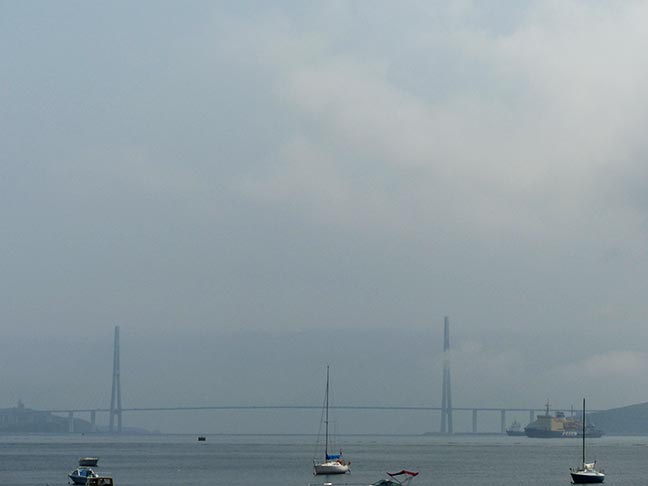
The
Russky Bridge (Russian Bridge) is a bridge built
across the Eastern Bosphorus
strait, to serve the that took place in Vladivostok
in 2012. The
bridge connects the mainland part of the city with Russky Island,
where the main activities of the summit took place. The bridge was completed
in July 2012. Russky Island used to be the top-secret
military base that served as a shield for the naval port in Vladivostok. Only
in 1995 did it open for visitors. |
|
|
|
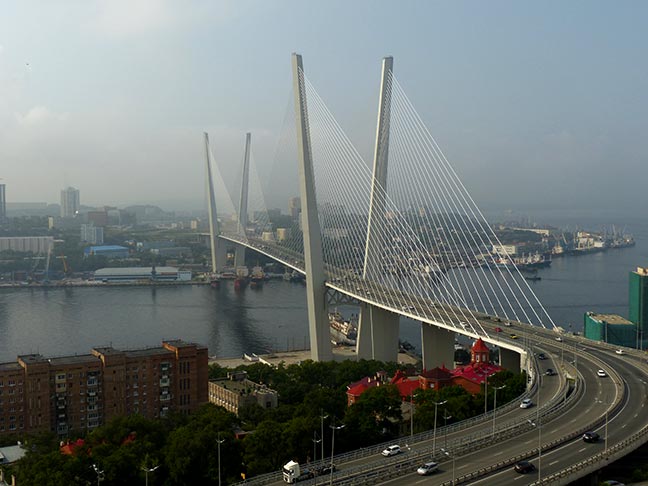
The Zolotoy Bridge
(Golden Bridge) is a cable-stayed bridge across the Zolotoy Rog (Golden Horn) . The bridge was also built for the Asia-Pacific Economic Cooperation
conference and officially opened on 11 August 2012. |
|
Swimmers near the city. We’ve just read that the city is to get the tallest statue of
Jesus Christ in the world! At 240’ it will be 150’ taller than the one in
Rio. A local businessman donated two acres of land overlooking the
sea and they are now raising $15 million to put the statue (created in 2013)
in place. The monument has the backing of the Orthodox Church and should
“boost tourism and encourage residents to believe in God.” |
|

|
|
The new Far Eastern Federal University opened in 2013. There were five universities in Vladivostok that merged into
one. The universities were in beautiful old buildings all over the city
before. The new university was built from scratch on Russky Island and
is amazing to see. The map on the left shows the school (red buildings), the
dorms (blue buildings) and the landscaped grounds. Busses run continuously along
the inner arc carrying the students to classes. |

|
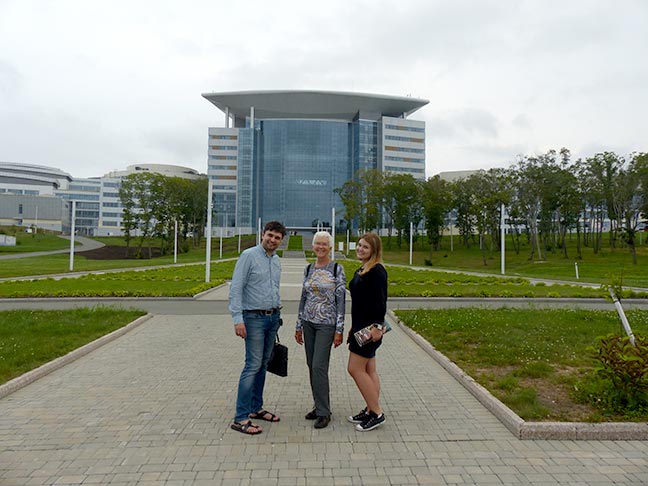
This building is in the center of the arc and contains the
administration, cafeterias and restaurants. On each side are the classrooms
and laboratories. The entire place was built in just a few years. At left in the photo is Serge, our driver who is an architect.
He has worked in Japan and Australia designing modern Japanese-style
buildings. He also speaks Japanese. At right is our guide Xenia. She spent her junior year in
Tucson and liked it so much she went back to Arizona State for a BA in
Business. She now attends school here to add law. |
|
|
|
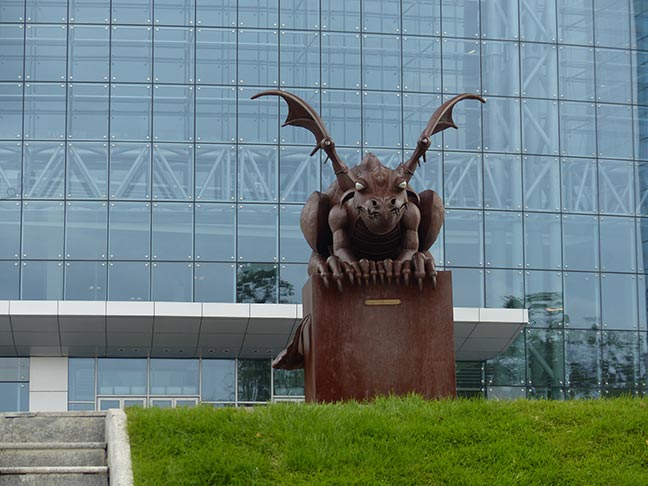
This funny statue has become the school mascot. |
|
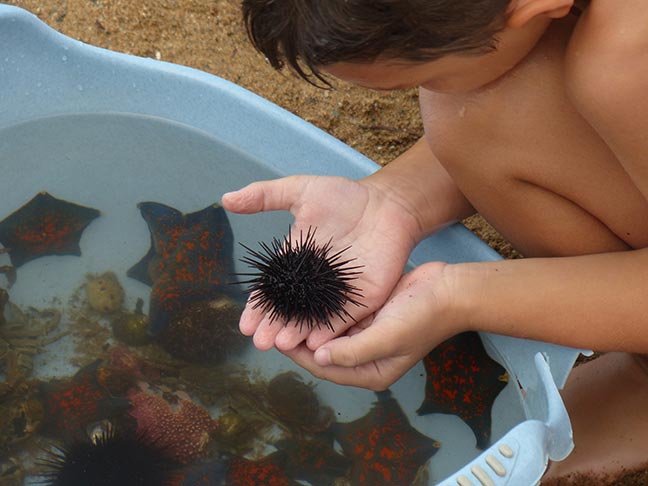
On the bay along the school grounds we looked down from the
walkway to this boy who had collected all these wonderful sea animals! |
|
|
|
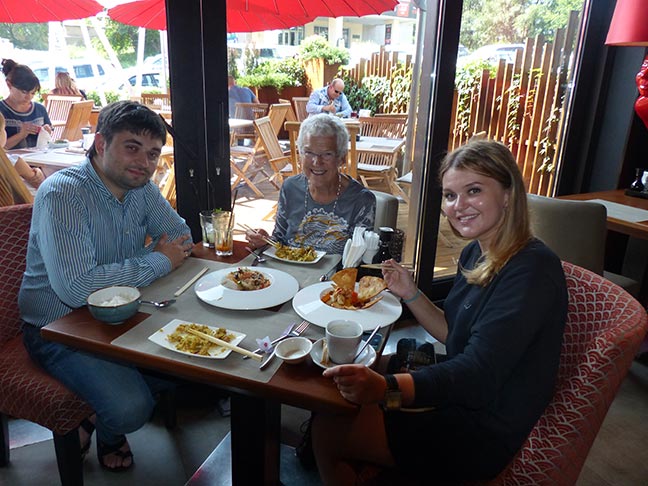
We invited them for dinner as they were interesting as well as
fun to be with. Note the very modern dishes as we consumed another “fusion”
meal. We had this experience throughout our trip in Russia. The
guides, and sometimes the drivers were professionals who did occasional
guiding to maintain their English fluency. |
|
|
|