|
|
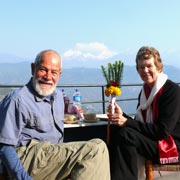
For her 70th birthday, Yvonne wanted to go
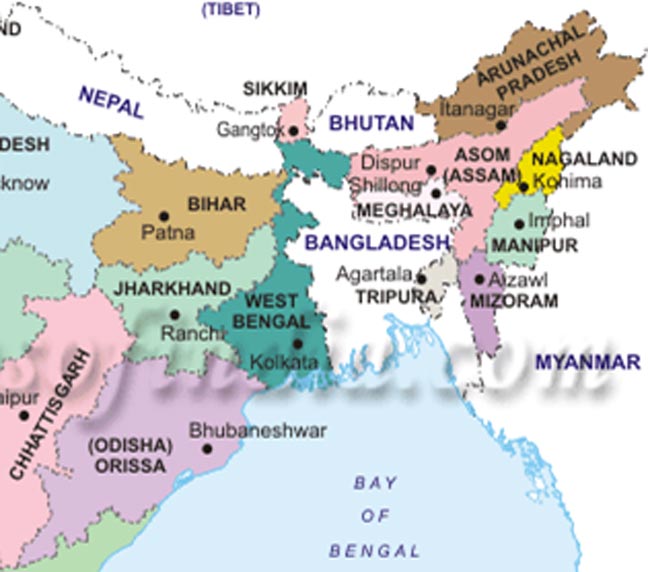
mountain biking in Sikkim (a former Himalayan kingdom that is located south
of Tibet and between Nepal and Bhutan). Sikkim has been part of India only
since 1975. Sikkim is at center top of the map at left. After a long-planned trip with a British company didn’t
materialize (not enough participants), Yvonne contacted the company Naturebeyond in Siliguri in the northern part of West
Bengal. One of the owners, Pallab Bhattacharya, patiently and carefully
designed an itinerary tailored to our exact wishes. Before the biking tour, we spent a few days at a nature
reserve east of Siliguri (map of the area at the bottom of this page) to
adjust for the 12-hr time difference. After the biking tour we went to Kolkata and then toured
Orissa (described separately). |
|
|
|
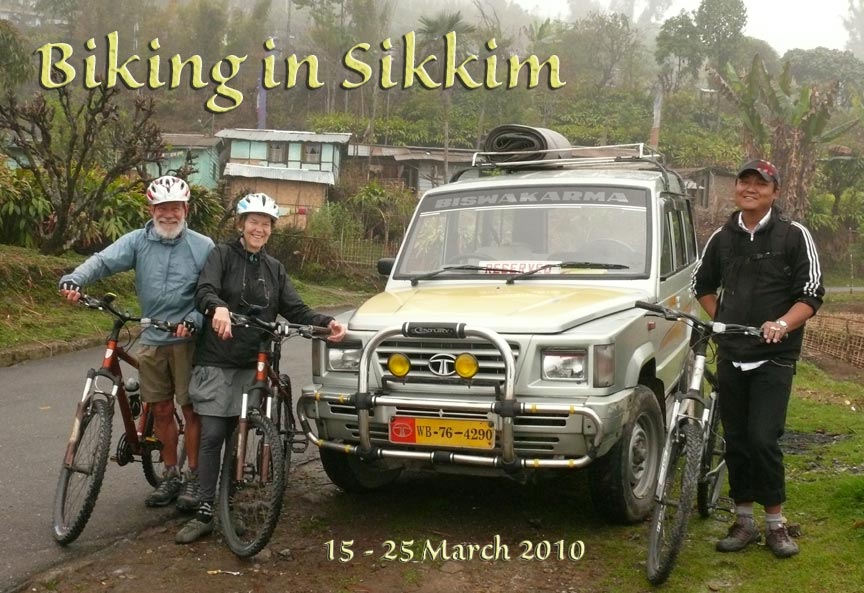
We started our
biking tour just north of Siliguri in West Bengal and crossed the Sikkim
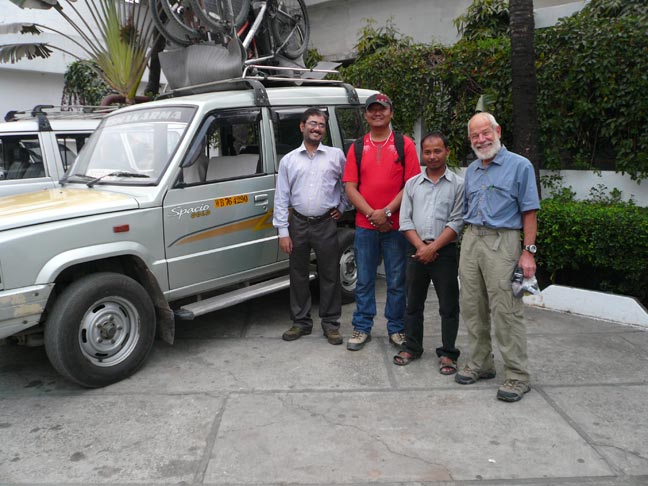
border north of Darjeeling two days later. The picture on the right
shows our vehicle (with the bikes on top), Pallab, Karma, Joy and Juergen. Pallab (left) even
helped us get set up with a computer USB modem of an Indian cell phone
company. This gave us internet access in the most remote areas as long as
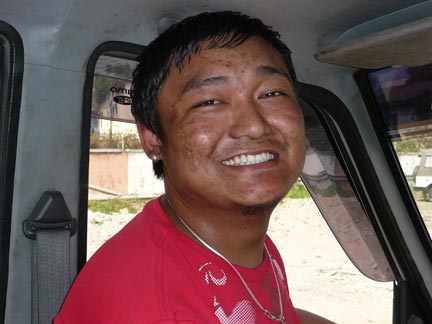
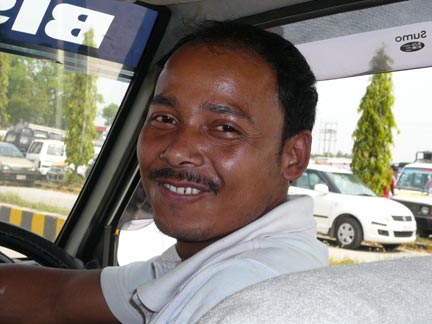
there was cell phone coverage. Karma was our biking guide. He is from Sikkim,
has a Tibetan father and a native Sikkimese mother.
Next to him is Joy, our driver, who is a Raj Bangsi
of West Bengal. Both were absolutely perfect - cheerful and fun to be with.
They treated us like royalty which added to the trip’s being an unforgettable
memory. Below are Karma and
Joy. |
|
|
|
|
|
|
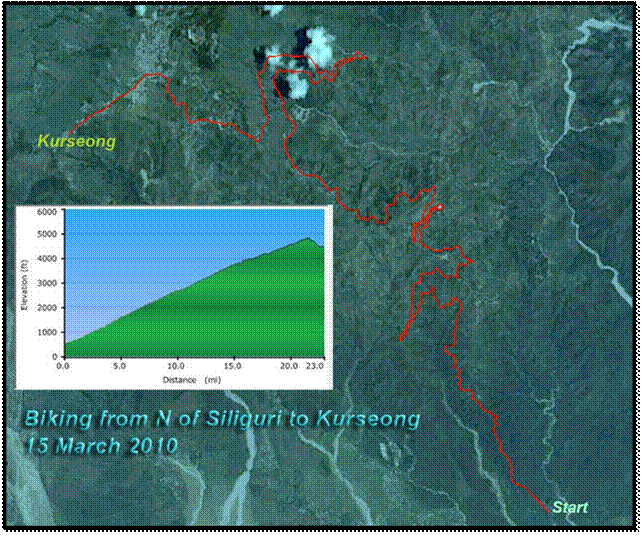
We
started biking just outside Siliguri and went steadily uphill for over 20
miles. By the
time we got to Kurseong, we had pedalled
from an elevation of 600’ to 4800’ in 4.5 hours (moving time). Our
GPS track is in red overlayed on Google Earth. |
|
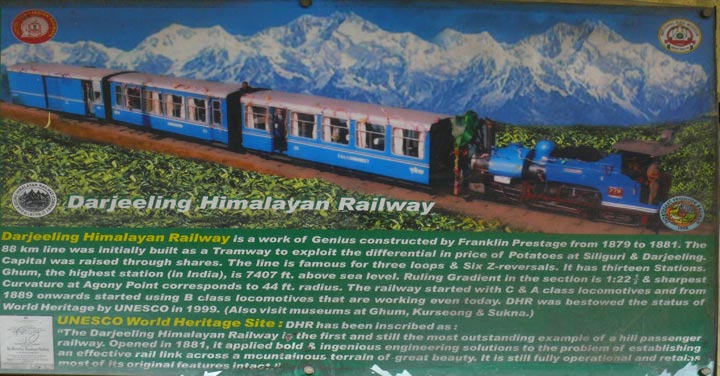
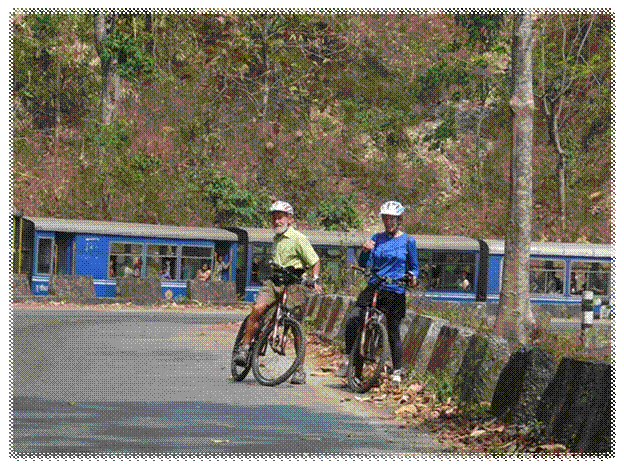
The reason for the steady 3.7% climb was that the road
pretty much follows the railroad track of the Darjeeling Himalayan Railway
(the “Toy Train”) a UNESCO World Heritage Site. |
|
|
|
|
|
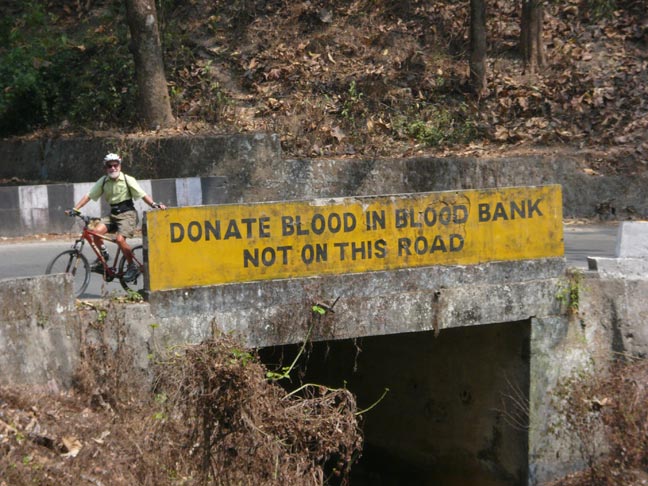
The roads are narrow
and winding and have many signs like the one on the right. Here are some
others: “Life is short, don’t make it shorter” “Be soft on my
curves” “This is a highway,
not a runway” “Either drink or
drive” “Slow drive, long
life” “Drive with care,
life has no spare” “Live for your
today, drive for your tomorrow” “Better late than
never” “Reach home in
peace, not in pieces” |
|
|
|
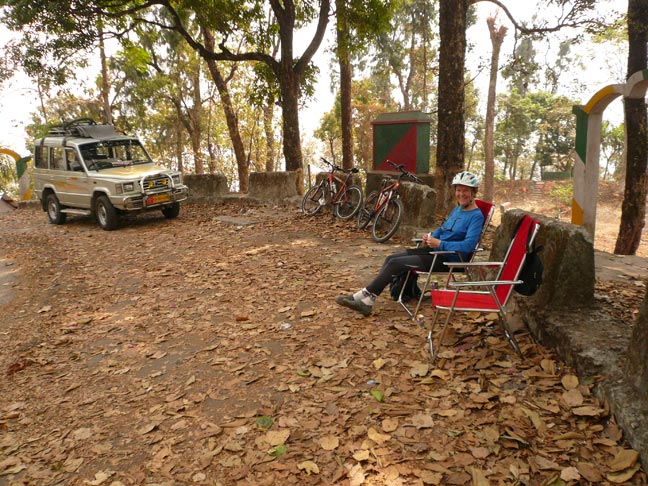
We were given red
velour chairs and pampered with snacks at our rest stops and excellent box
lunches at our lunch stops. The road was narrow
with cliffs on one side and drop offs on the other which made it rare to find
a pullout like this one for our snack breaks. This first day of biking was on
a secondary road which happily for us meant there was little traffic. After being
exclusively addressed by Karma with “Sir” and “Ma’am” Yvonne told him to call
us Juergen and Yvonne. His reply: “I can’t do that, Ma’am.” |
|
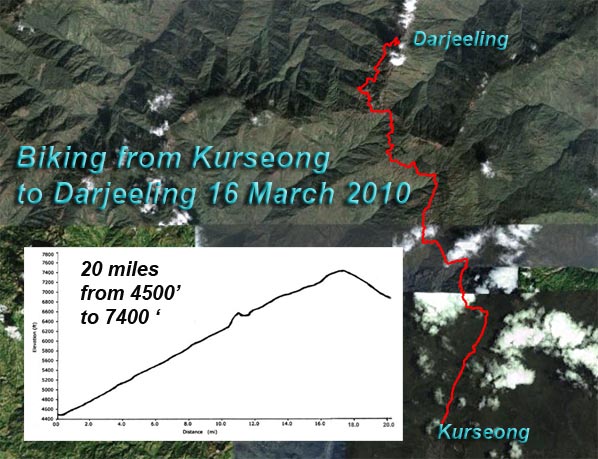
The second day of
biking from Kurseong to Darjeeling wasn’t much easier. We climbed some 3900
feet. The problem here was
that the entire way was being resurfaced. There were piles of rocks and sand,
lots of traffic, road construction equipment - and the road was very narrow. Fortunately, the drivers in Sikkim are both
very careful (they don’t race around) and good, so we weren’t afraid of
getting hit. People often cheered us on – even with “go Papa, go Mama!” which
made us laugh. |
|
|
|
Many Indian states
have hugely diverse populations of different ethnic composition and different
languages. Our guide and driver
spoke six different native languages and used Nepalese to communicate with each
other (not native to either one). Both knew only a little Hindi – learned by
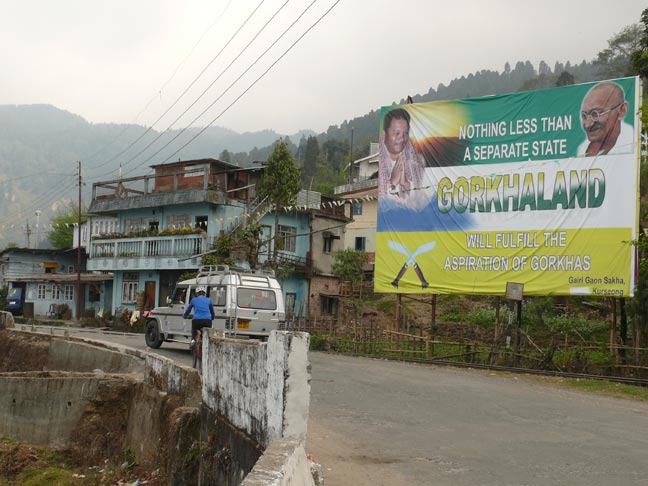
watching Bollywood films! One political
problem in West Bengal is a movement by members of the Gorkha population to
establish a separate Indian state, something the central government does not
support. Occasionally, strikes and road blocks cause travel delays. |
|
Note that Sikkim has
left-hand traffic. Not only did we have to get used to that – it also meant
that the “rear view” mirrors we put on our glasses had to be used on the
right side. There are also
almost NO bikes. It’s just too hilly. |
|
|
|
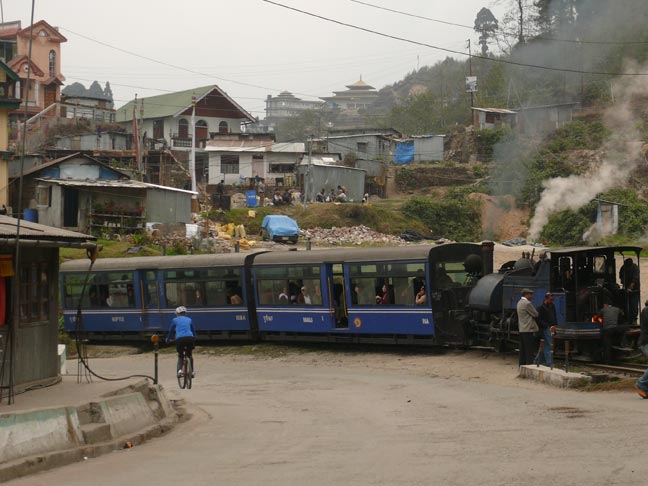
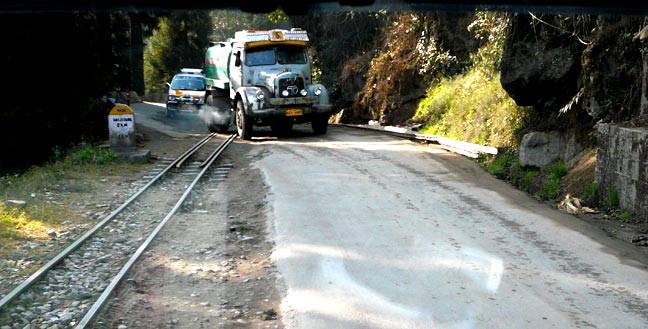
Our frequent crossing
the railroad tracks was not easy. The roads were
narrow and the tracks had to be crossed at an angle to avoid slipping into
the gaps. The road condition
was like this for the entire 2nd day – but from then on the roads had
very little traffic again. This was an experience – that would have been
dreadful if the drivers hadn’t been so nice to us! |
|
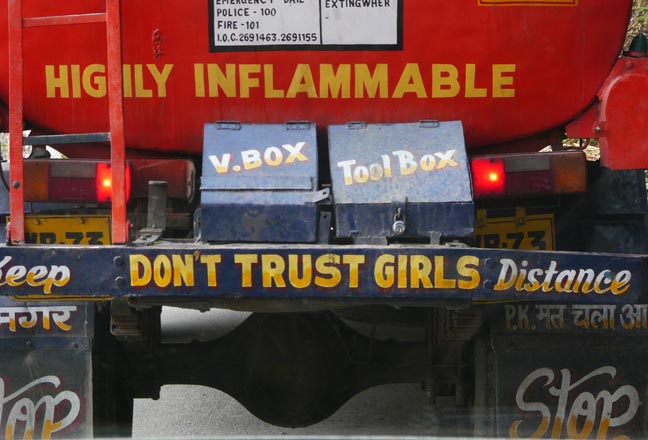
Besides funny road
signs, some trucks are highly entertaining. |
|
|
|
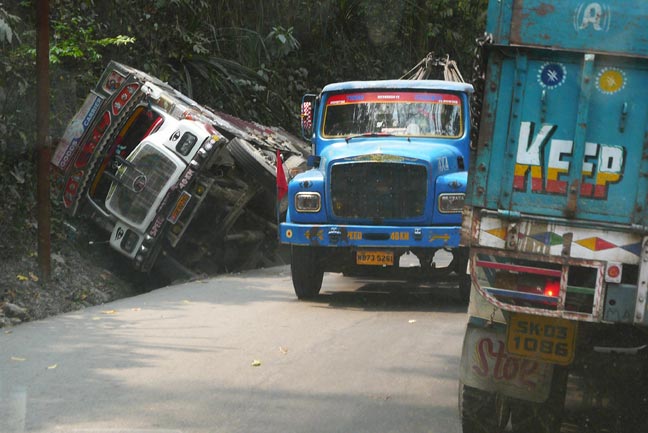
The narrow roads and
steep shoulders do cause accidents. |
|
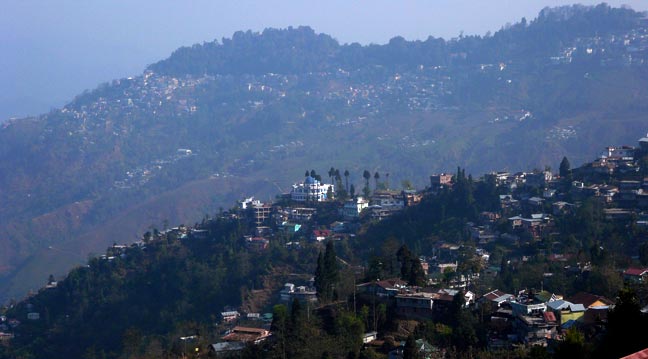
Darjeeling is a
delightful town at an elevation of 7000’. It was developed by
the British in the mid 19th century as one of their “hill
stations” and is most famous for the tea that’s grown everywhere nearby in
extensive plantations. |
|
|
|
Sikkim has the third
highest mountain in the world (only Mt. Everest and K2 are higher). The mountain’s name
is Kangchenjunga; it is 28,169 ft (or 8,586 m) high. The name means “The Five
Treasures of Snow” as it contains five peaks, four of them over 28,000 feet. It’s visible from
Darjeeling in the picture on the left which was taken from our hotel window.
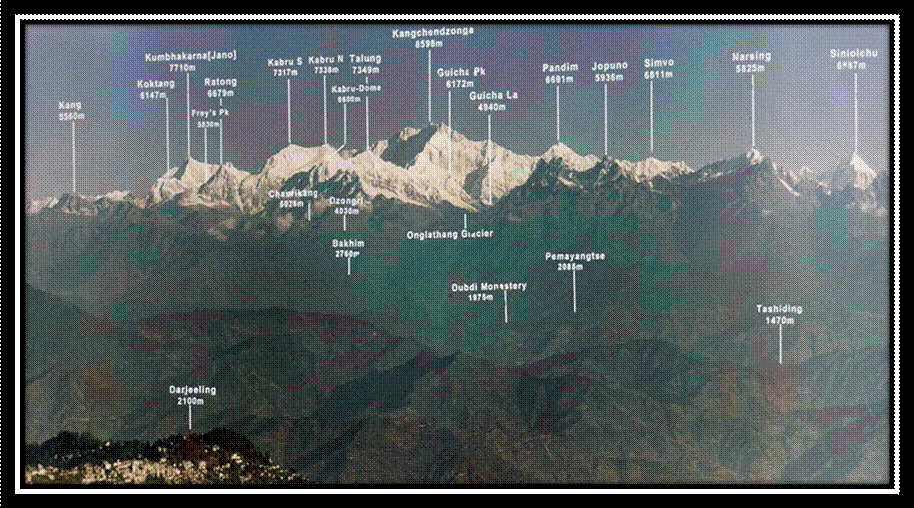
We made a sunrise excursion to a view point called Tiger Hill. The chart
below shows the major mountains visible from that site. |

|
|
|
|
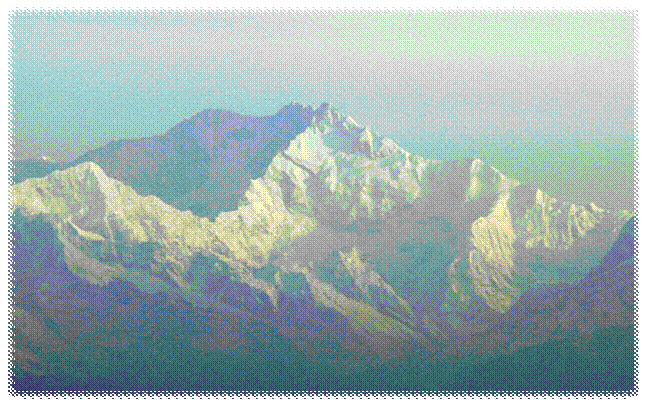
This is our
telephoto of Kangchenjunga in the morning sun taken from Tiger Hill. |
|
|
|
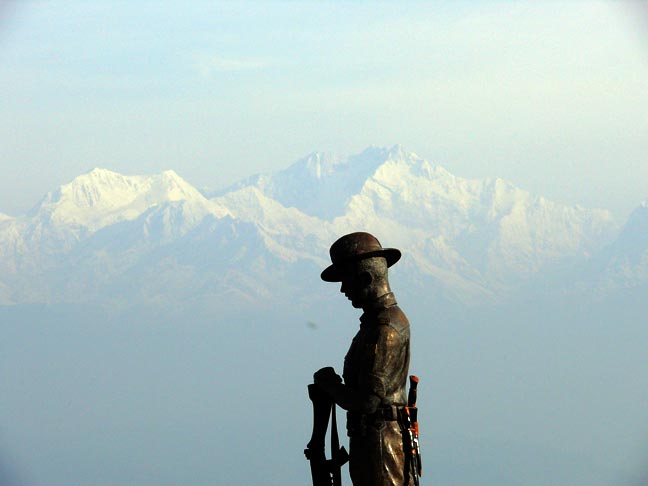
On the way back to
the hotel, we stopped at the Gorkha war memorial which is dedicated to the
Gorkha soldiers the British used for their military campaigns. |
|
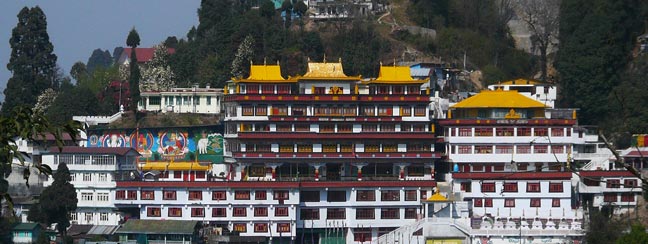
Close to Darjeeling are a number of fascinating Tantric Buddhist monasteries. On the right is the
Dali monastery of the Kagyu sect. Built in 1971, this monastery forms the
headquarters of Drukchen Rimpoche the XII, the
supreme leader of the Kagyu lineage. Tantric Buddhism
originated in India around 600 CE and spread into Tibet where it flourished
and became firmly established while Buddhism in India practically disappeared
eventually. Today, Tantric Buddhism is practiced in Sikkim, Tibet, Bhutan, Nepal and in a region of NW India - Kashmir/Ladakh and Himachal Pradesh where the Dalai Lama has his
exile government. We’ll visit that region next! (Summer, 2011) |
|
|
|
|
|
|
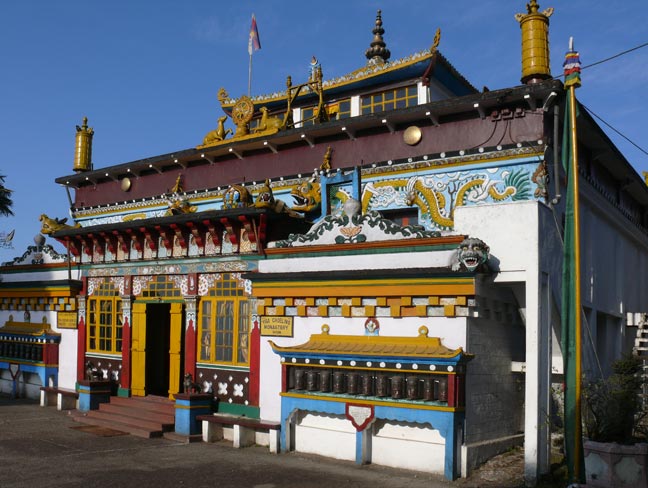
Also close to
Darjeeling, in the city of Ghoom, is the Yiga
Choeling monastery which was established in 1875 by the Tantric Yellow Hat
sect. The Dalai Lama heads
the Yellow Hats, the largest Tantric Buddhism sect. |
|
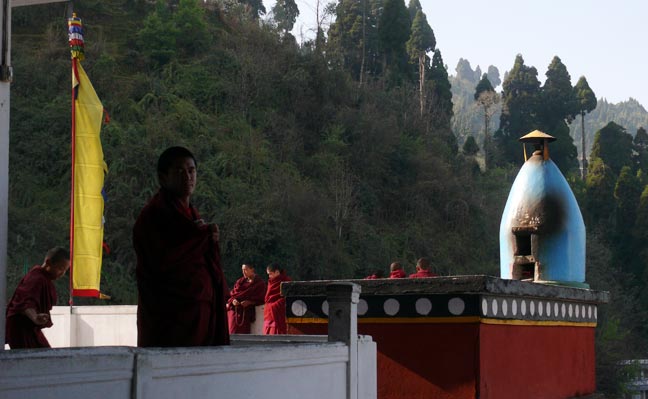
Monks on a platform in the back of the Bhutia Busty
monastery (Red Hat or Nyingma sect of Tantric Buddhism). The Tibetan Book of the Dead was found here and
translated into English in 1927. Later in our stay in Sikkim we witnessed a
burial ritual following the Tibetan Book of the Dead. |
|
|
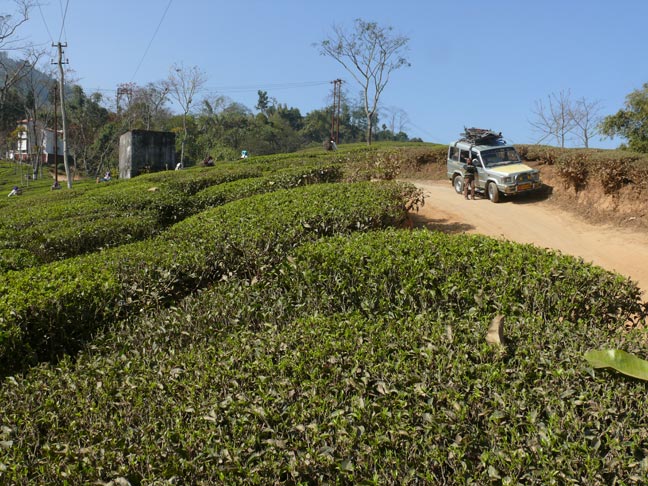
Tea plantation north of Darjeeling (with our vehicle and
Joy). We thought that having a guide named Karma and a driver
named Joy was wonderful! Joy is a common man’s name in his W. Bengali ethnic
minority which is Hindu but has its own language and only about 50,000
members. |
|
|
|
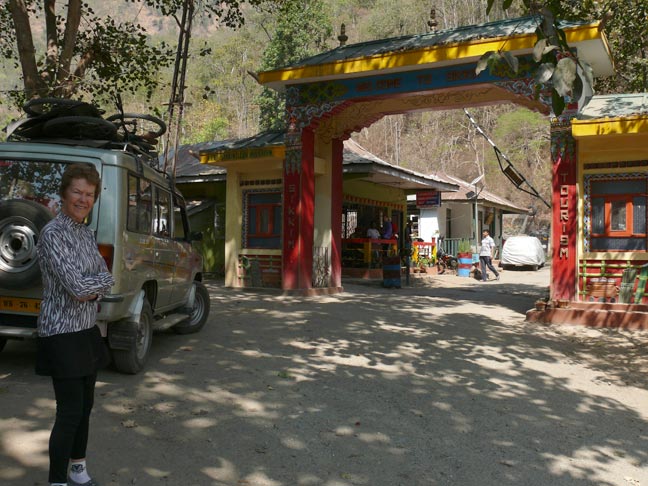
This is the Sikkim
border which is at the bottom of the mountain Darjeeling is on. Because of border
disputes and other unsettled political issues (primarily with China because
Sikkim borders on Tibet) a special permit is required to enter Sikkim. Our biking in Sikkim
consisted of going down a mountain, crossing a river, and then climbing up
the other side. Over and over again! Level rarely happens in Sikkim! |
|
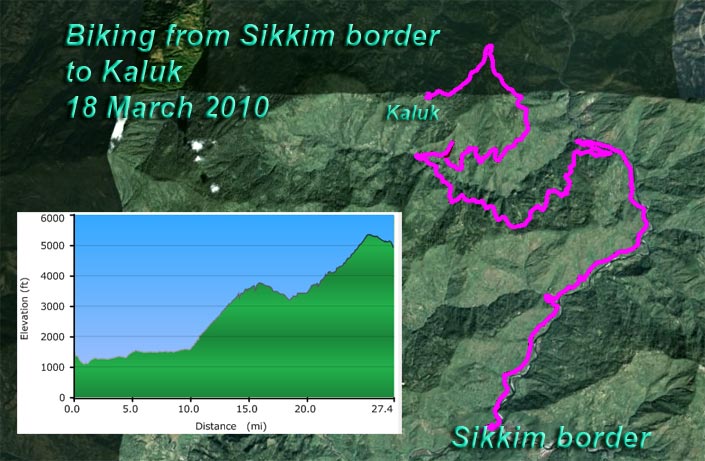
Just like our first
day, our third day of biking in Sikkim wasn’t easy: we climbed 5000 ft in
about 25 miles (of 28)…and it was warm! |
|
|
|
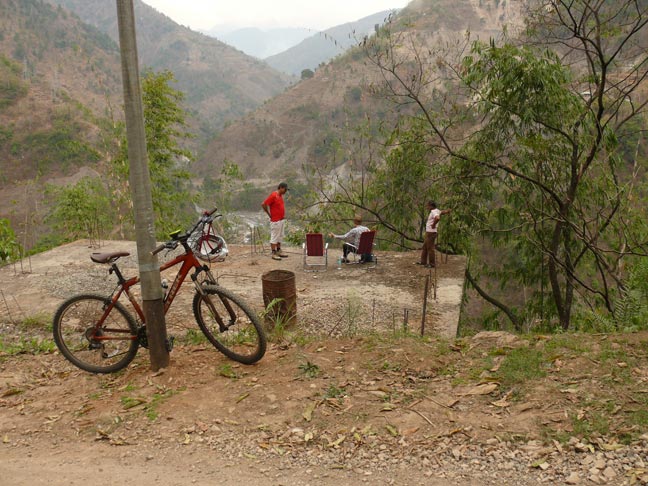
Another snack break with a view. It made us smile to
come around a curve and spot our red chairs waiting for us! We’d crossed the
river below us not long before. A typical nice
memory about Joy’s quick humor: Yvonne was taking her backpack out of the SUV
and Joy offered to carry it for her. She said she was ok because it was
light. Joy answered that if it was heavy he wouldn’t have offered. (Of
course, he would have!) |
|
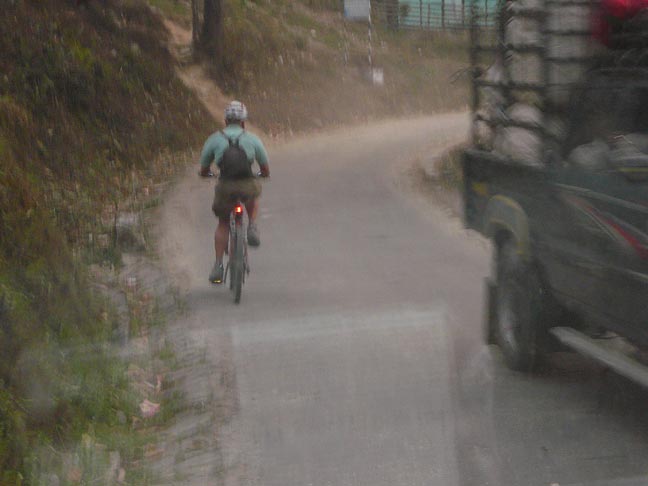
It was pretty late
by the time we neared our hotel in Kaluk. |
|
|
|
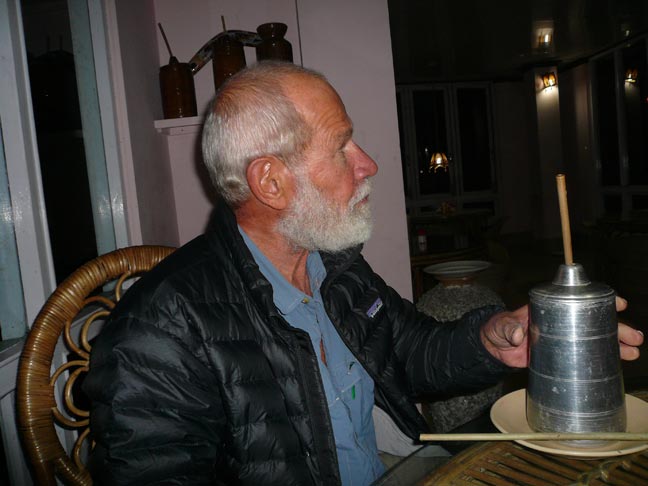
The local millet beer
is fondly clutched by Juergen…. This was Juergen’s
first millet beer (he had barley beer in Tibet). Here he’s getting directions
on how to stir it. He didn’t know then
that he would taste more millet beer later in 2010 - on a different
continent, Africa, in the Dogon area of Mali. |
|
The hotel in Kaluk
had a wonderful view of Kangchenjunga. Pallab had selected the best room for
the view of the mountain in each place we stayed. For several days we
kept cycling closer. |
|

|
|
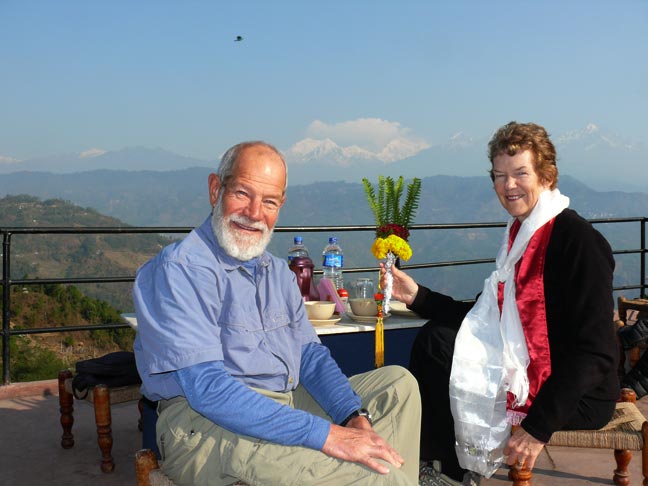
We started Yvonne’s
birthday with breakfast on the lodge’s roof with a wonderful view of
Kangchenjunga. Karma gave her the
red scarf. The host gave her the
white scarf and the flower arrangement, which was made by his 10-year old
daughter. |
|
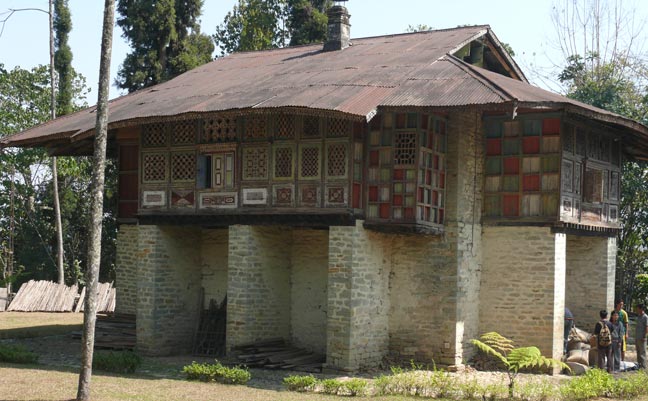
The people in Sikkim
had a very distinct and pretty architectural style. Unfortunately, very
few houses are left. Here is one of them in the very old style. |
|
|
|
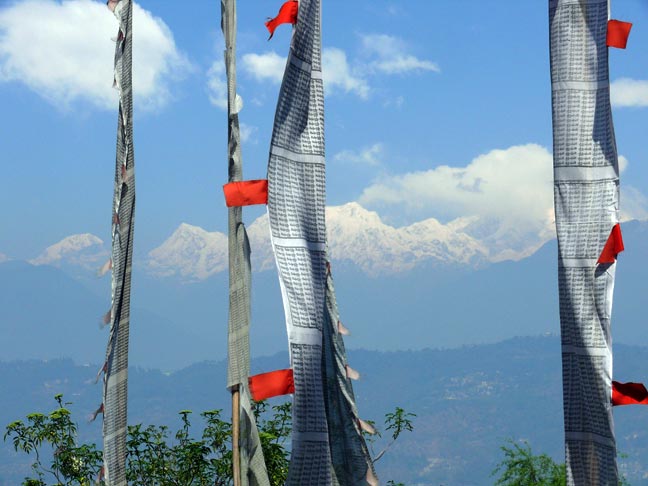
We visited the Rinchenpong monastery near Kaluk. …here again with a
view to that wonderful mountain. |
|
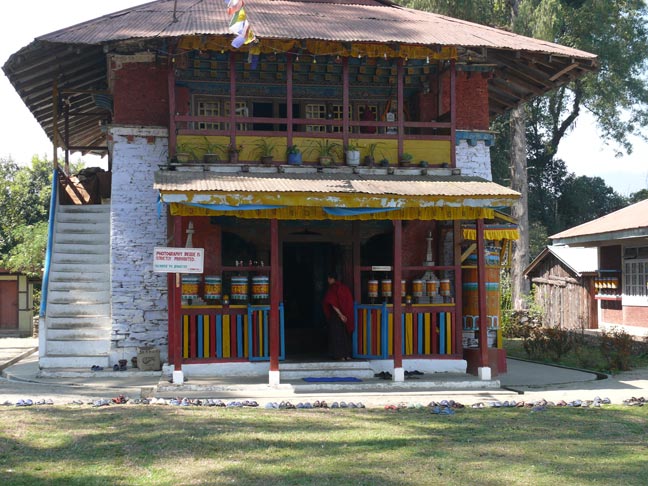
The monastery was
very interesting in two respects. One was a burial service that lasted over 70
days (not continuously, but on selected dates). There was a lot of chanting
and music inside but pictures were not allowed. The other
interesting feature inside was the Tantric non-duality altar sculpture. We have seen many of
such presentations but never one in which the Buddha image was in one color
(blue) and the female partner likewise in one color (white) with both of them
nude. |
|
|
|
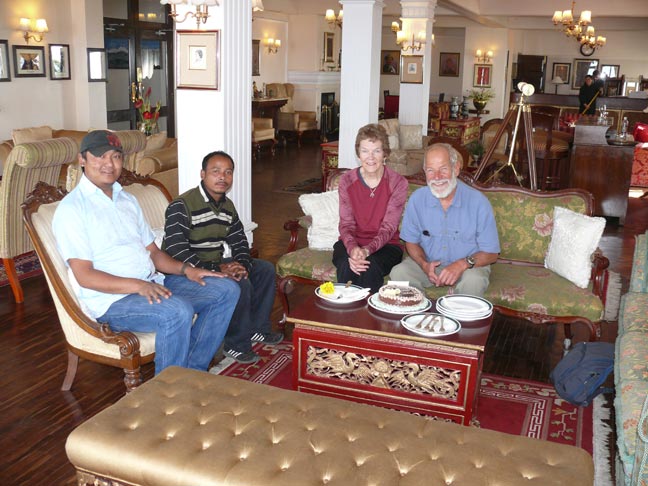
From Kaluk we
proceeded to Pelling by car (see map at the end) and stayed at a fancy old
British hotel. Pallab arranged for
the birthday cake which we shared with Karma and Joy. We celebrated by
having sherry on the lawn with a view of the mountain. |
|
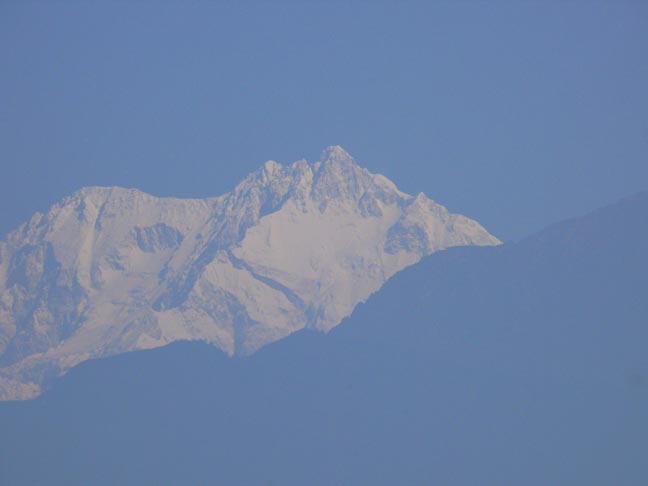
We lucked out seeing
our favorite mountain again from Pelling. Later, while waiting
at the Siliguri airport to fly to Kolkata we met a young German couple who
had planned to hike to the base camp. They arrived in Sikkim just a few days
after we did but never even saw the mountain once as it started to rain when
they arrived. They decided to continue their holiday elsewhere. The rain caused us
to miss only our last day’s planned view of it (when we were only 25 miles
away!). We were SO lucky! |
|
|
|
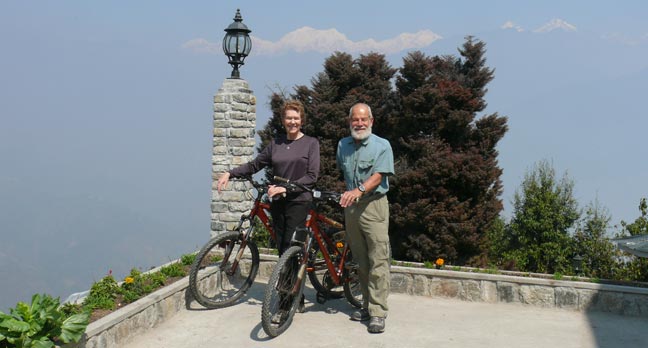
We had to pose with
our favorite mountain in the background – with our bikes - even though we were
visiting monasteries that day. |
|
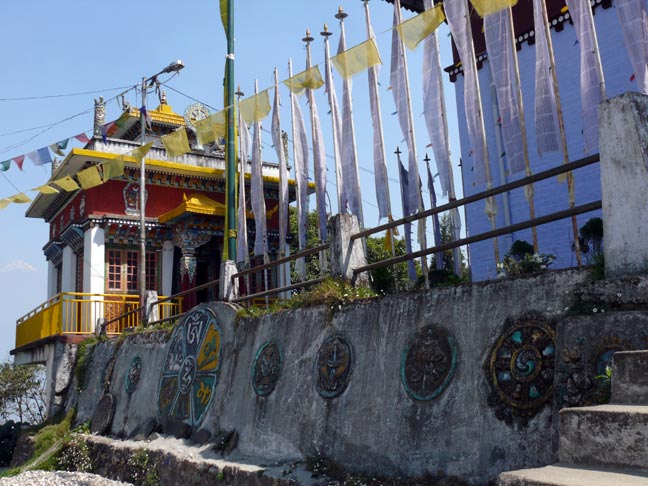
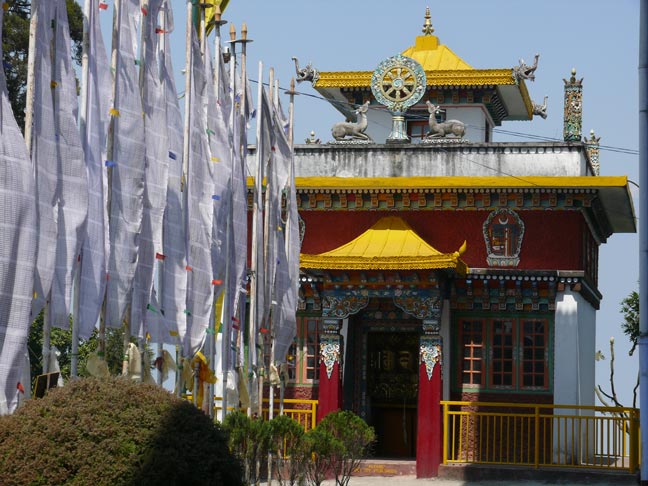
We spent a day in
Pelling and visited the Pemayangtse monastery which dates from 1705. It is the head of
all the other Nyingmapa monasteries in Sikkim |
|
|
|
|
|
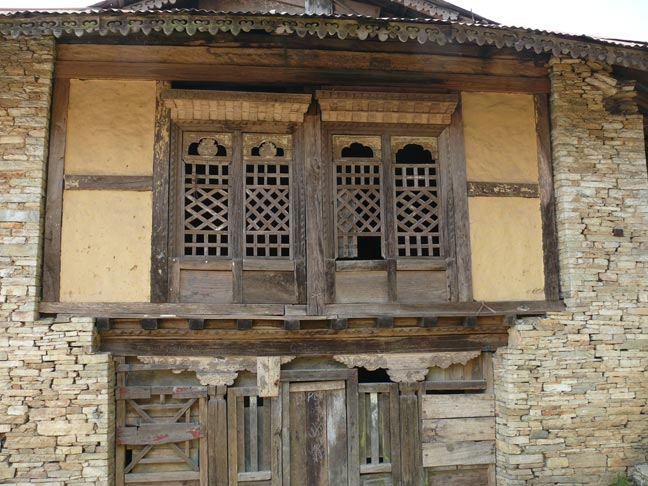
Some of the old woodwork
at the Pemayangtse monastery. |
|
|
|
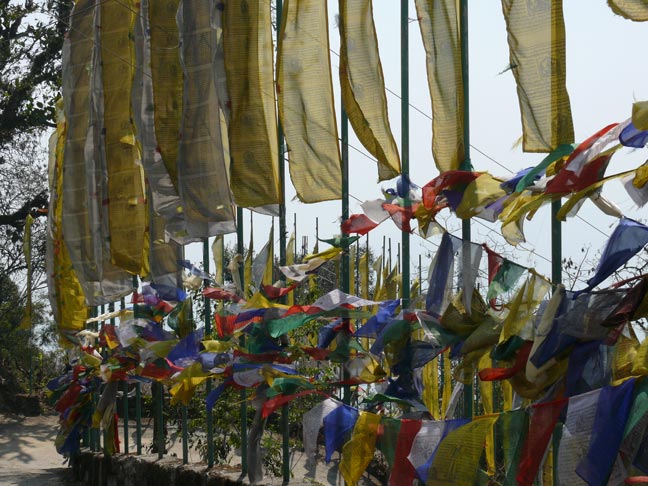
Near the above
monastery are many prayer flags and below… |
|
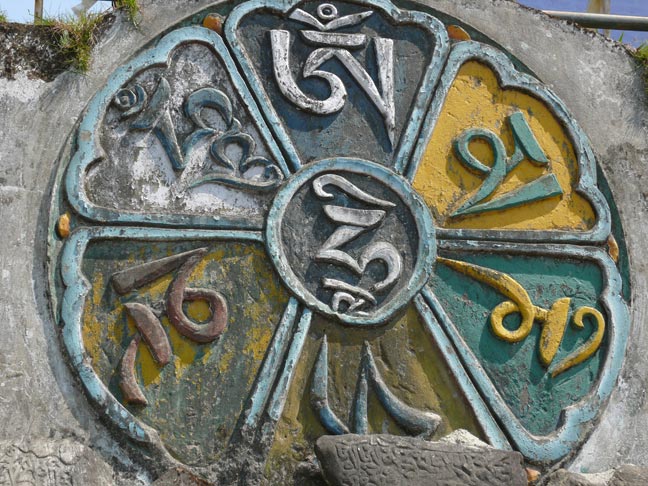
…a circular
depiction of the mantra Om-Ma-Ni-Pad-Me-Hum (‘Hri’
in the center if expressed in a mandala form like here) in Tibetan
characters. This is the mantra
of Avalokiteshvara (Chenresig in Tibet) whose present incarnation is the
Dalai Lama. Mani means jewel,
Padma means lotus. The background of
this page depicts the same mantra written linearly. |
|
|
|
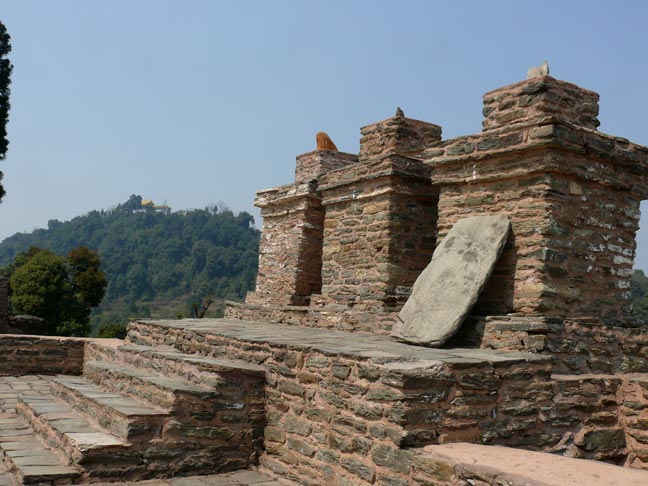
Two miles south of Pelling
is the Rabidentse, the second capital of Sikkim which dates from the late 17th
century. The three chortens
on the left were for the royal family. On top of the hill
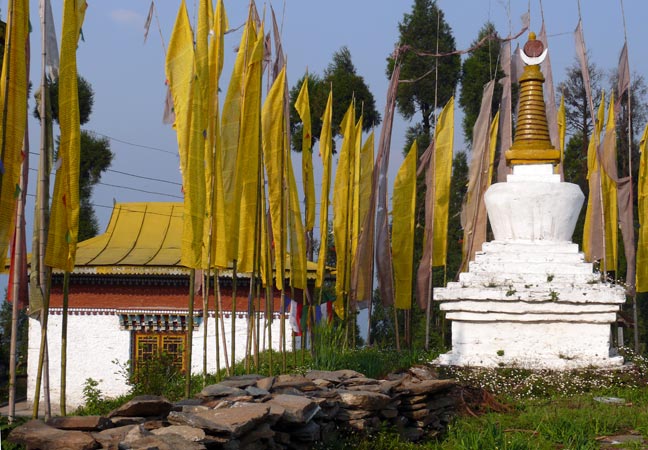
opposite is the 17th c. Sanghak Choeling monastery, Sikkim’s
oldest monastery. We visited it next. |
|
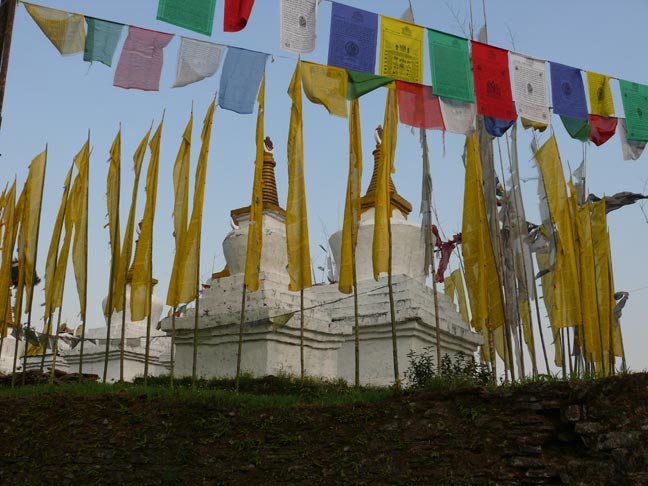
The Sanghak Choeling
monastery belongs to the order of the Nyingmapa sect. |
|
|
|
|
|
On our way from
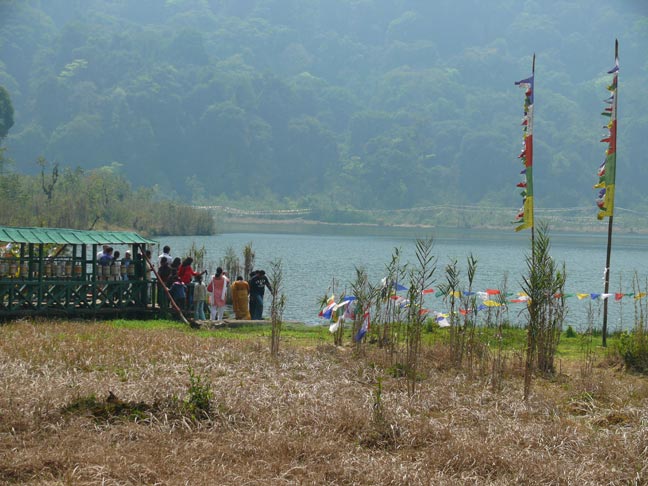
Pelling to Yuksom we visited a famous pilgrimage site, the sacred Kecheopalri
lake. It was some distance off of our biking route, so we took the car for
that detour. The lake’s original
name meant “Heaven of Padmasambhava” and is sacred to both Hindus and
Buddhists and is believed to be a wish fulfilling lake. It is also an
integral part of Buddhist religious pilgrimage involving Yuksom, the Dubdi
monastery, the Pemayangtse monastery, the Rabidentse ruins, the Sanghak
Choeling monastery and the Tashiding monastery (all of which we did). |
|
|
|
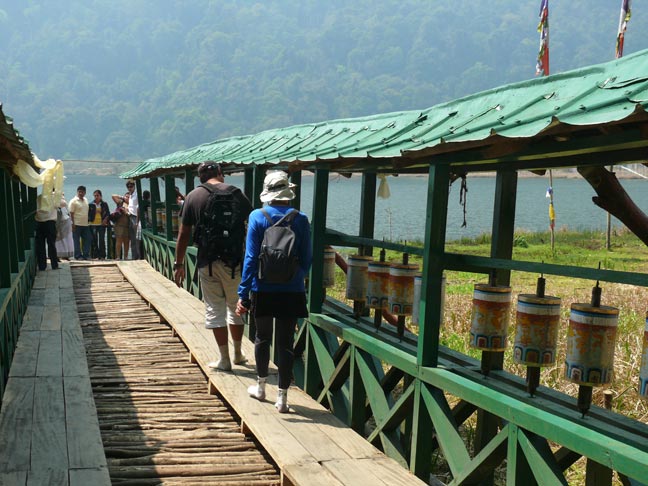
Karma and Yvonne are
spinning the Buddhist prayer wheels on a walkway leading to a Hindu site. Yvonne covered her
legs when biking not only to be respectful of their culture while on the
road, but because we often experience places when we bike where it would be
very bad to go with bare legs – like here. |
|
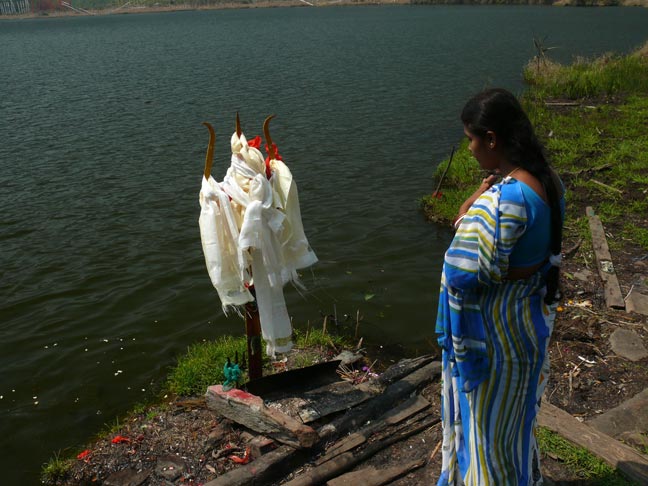
The trident
symbolizing Shiva at the end of the walkway. That’s where you do the wishing. Many Hindu tourists
from Kolkata visit Sikkim – because it is so peaceful and cool here (neither
of which Kolkata is). The only tourists we saw were from other areas of
India. |
|
|
|
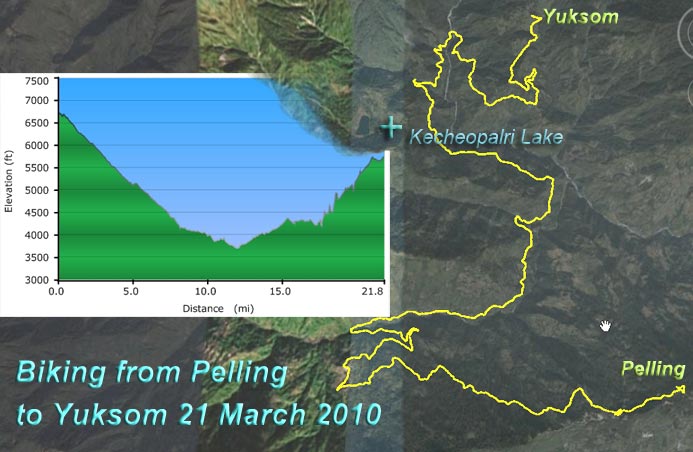
We returned to the biking
road after the visit of the Kecheopalri lake. The biking downhill
from Pelling was much fun – we’d “paid” for it with so much climbing the
previous days! We started out in
pines and junipers with birds singing and wound up in palms before crossing a
river and climbing back up to pines. |
|
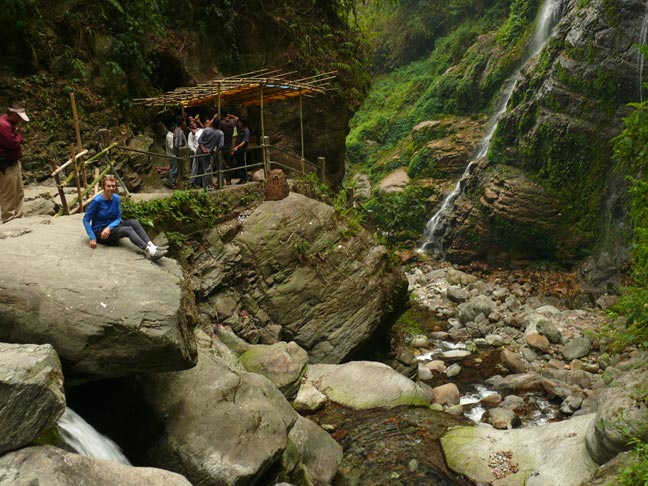
This is on the
uphill part of the biking profile where we took a rest at a nice waterfall. |
|
|
|
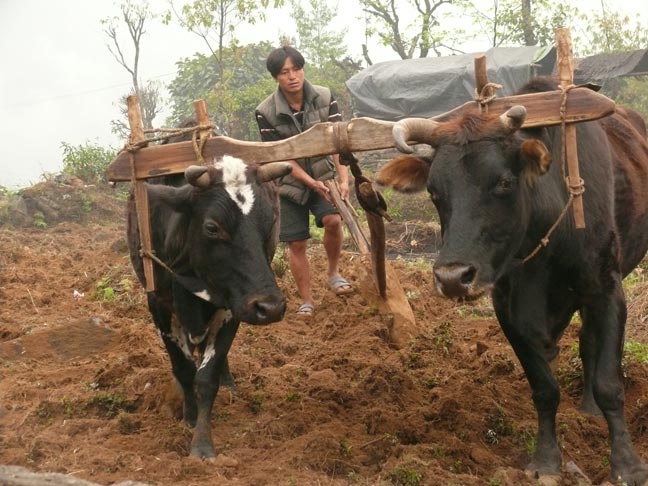
While climbing to a
monastery, we passed this timeless scene. Note the wooden plow. This was hard work as
the available area was tiny and rocky. He continually had to lift the plow
out of the ground and reinsert it. |
|
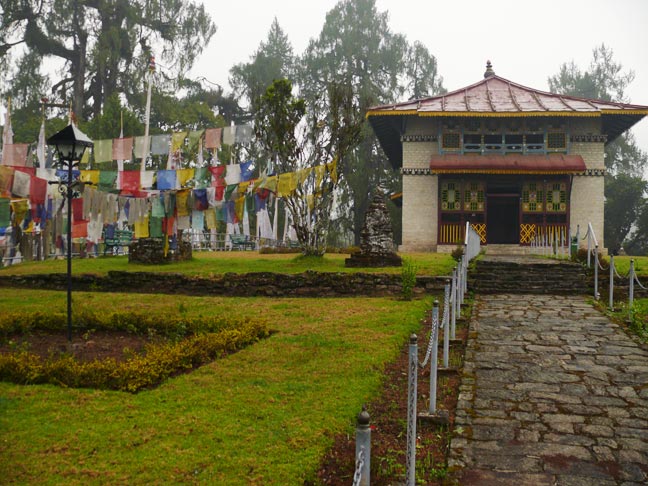
We climbed (walked
up through woods) to the Dubdi monastery near Yuksom which belongs to the
Nyingma sect. Established in 1701
it is the oldest monastery in Sikkim. It is central to the
history of Sikkim as it is closely linked to the founding of the State of
Sikkim at Yuksom in the middle of the 17th c. by Letsum Chenpo and his two
associate lamas. |
|
|
|
Like most monasteries,
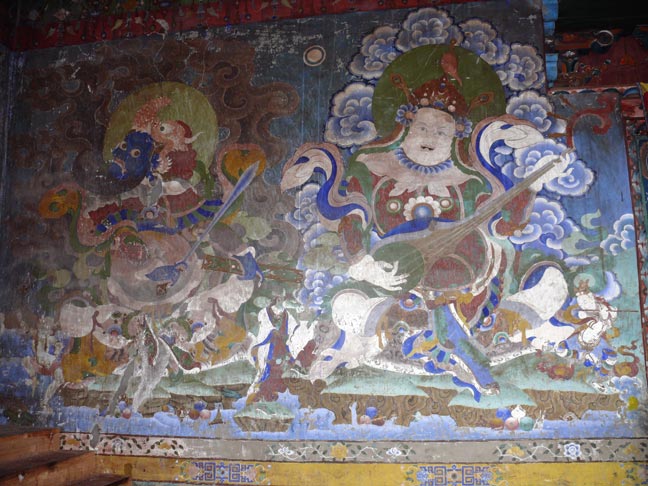
it has many elaborate paintings. The fellows on the left are guardians. The one with the
lute is Dhritarashtra, Guardian of the East. |
|
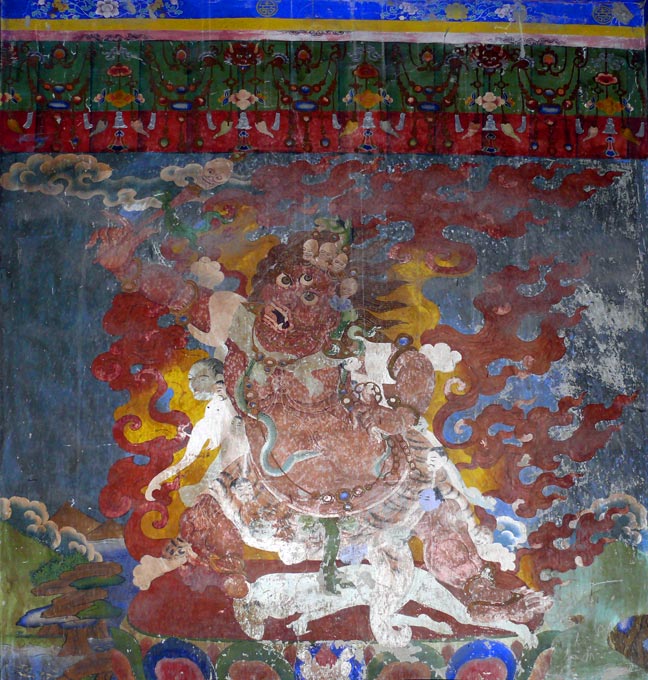
Wrathful Buddha. In Tibetan Buddhist iconography,
this is not a personification of evil or demonic forces. Rather, these
wrathful images are benevolent gods who are presented in this manner to
symbolize the amount of effort it takes to vanquish evil. |
|
|
|
Outside the Dubdi
monastery. |
|
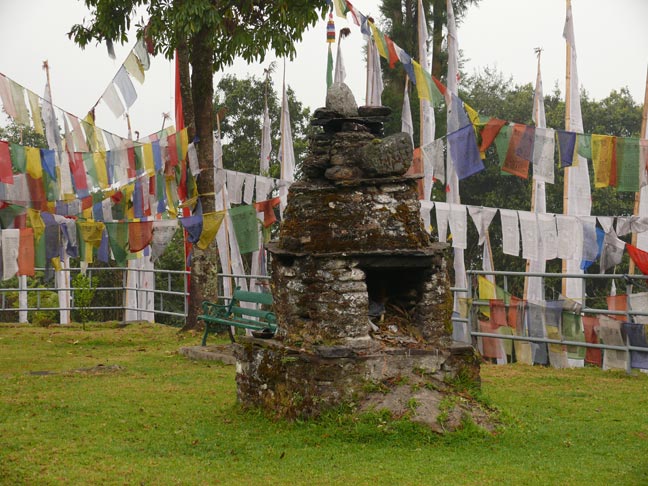
On the right is the
coronation throne of Norbugang. It is here where the crowning ceremony for
the first Chogyal (king) of Sikkim was held in 1641. The largest of the
four raised seats was for the great Nyingmapa Lama. On his right was the
king, the other two seats for high-ranking lamas. The large pine is
said to be from that time. |
|
|
|
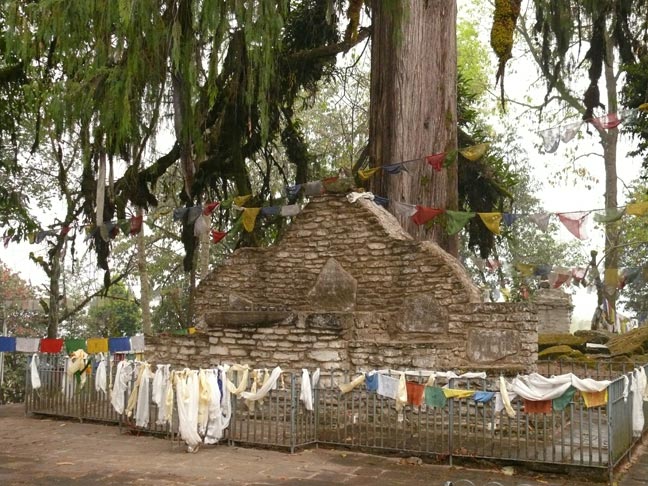
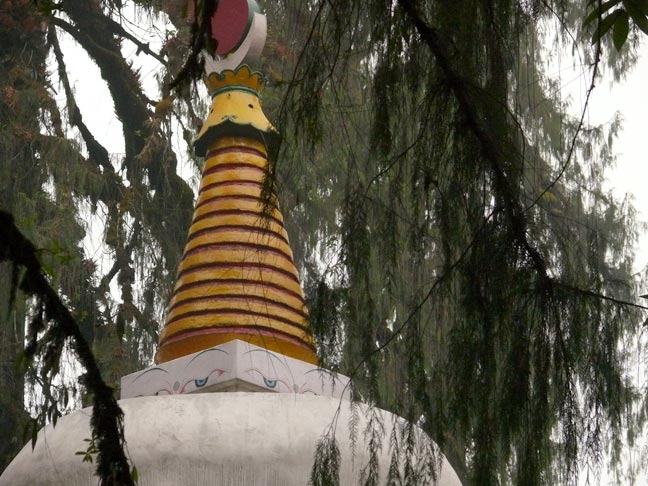
Next to the
coronation site is the Norbugang chorten (stupa) built in memory of the
coronation. It was built from
earth and stones that were brought from all parts of Sikkim, with the
coronation gifts put inside. |
|
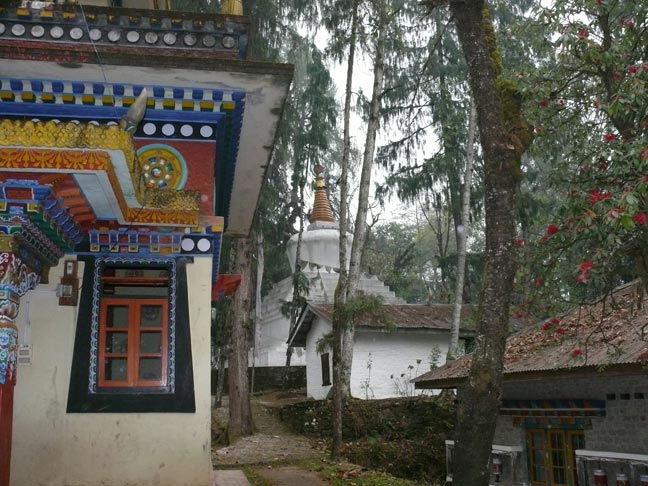
Temple and chorten
of Norbugang. |
|
|
|
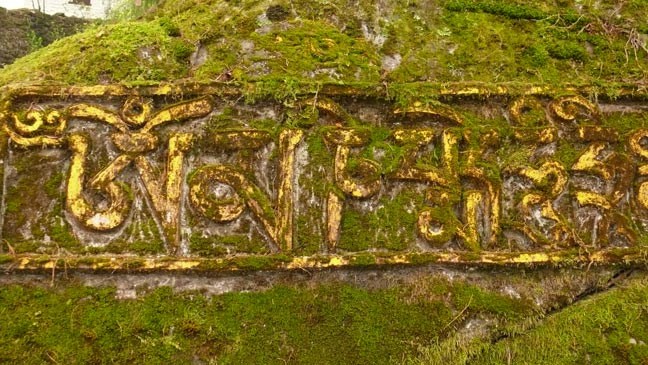
Another interesting
presentation of the famous mantra of Avalokiteshvara. |
|
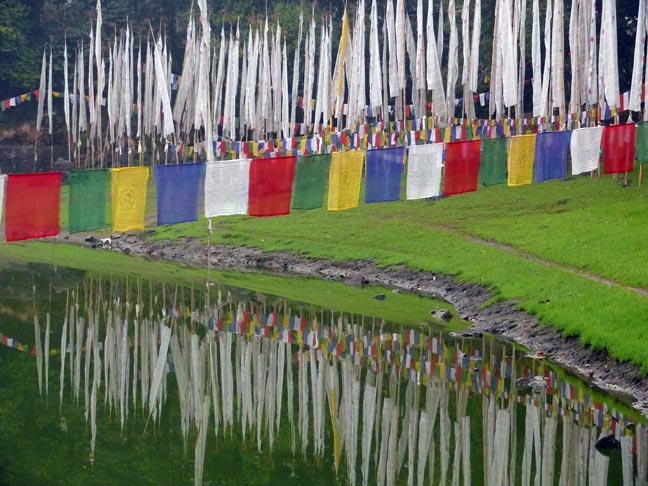
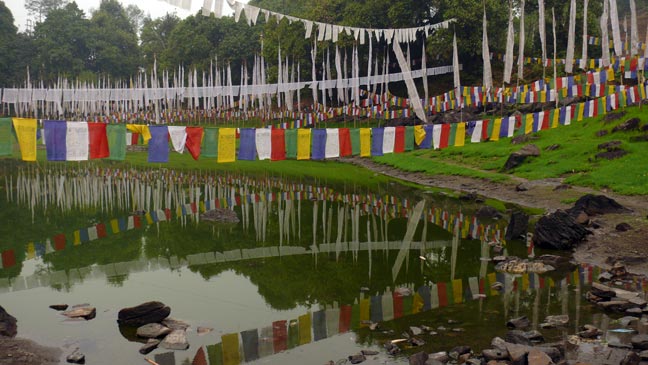
The nearby Kathok
Lake is a holy lake associated with the coronation site. |
|
|
|
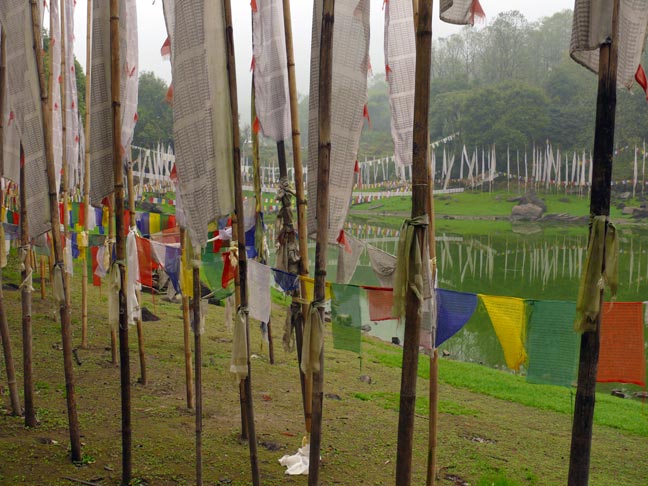
We walked around the
lake and enjoyed the serenity. We spent quite some
time there – we were the only visitors. |
|
|
|
|
|
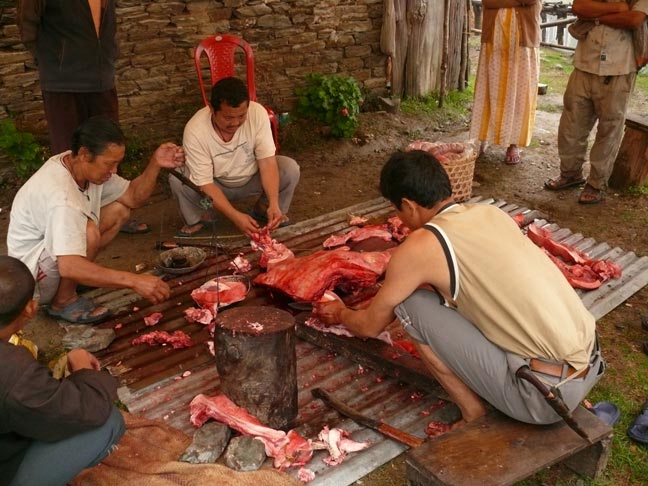
Continuing on, we
passed by this less serene scene. A butchered animal is being cut up and
distributed among the customers. |
|
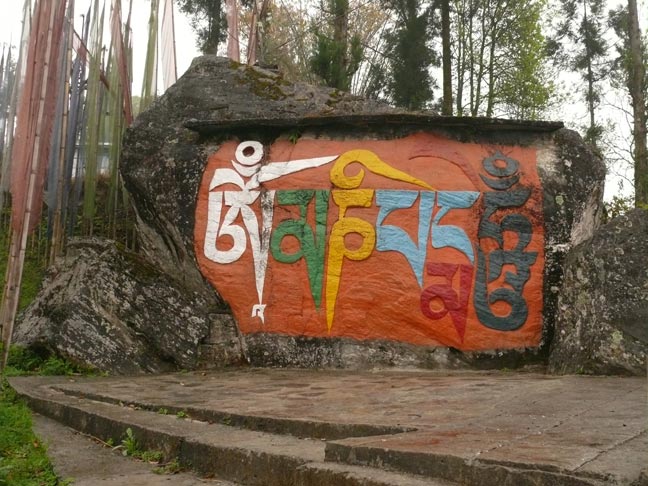
This is near the
entrance of the Tashiding monastery complex. It was built in 1717 and belongs
to the Nyingmapa order. This example of the
Om-mani-pad-me-hum mantra is the background for this page. |
|
|
|
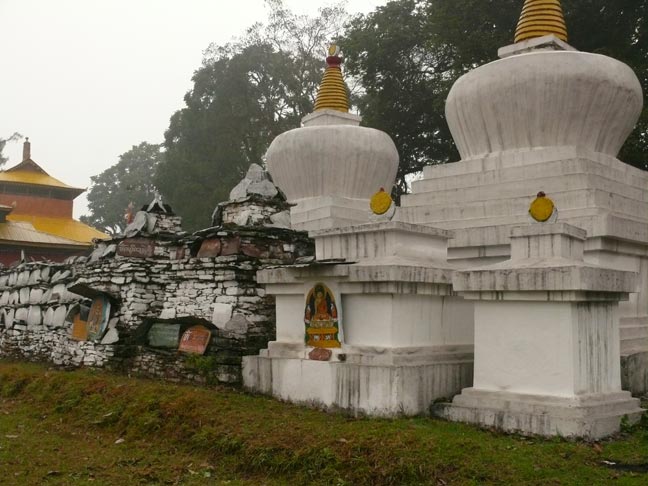
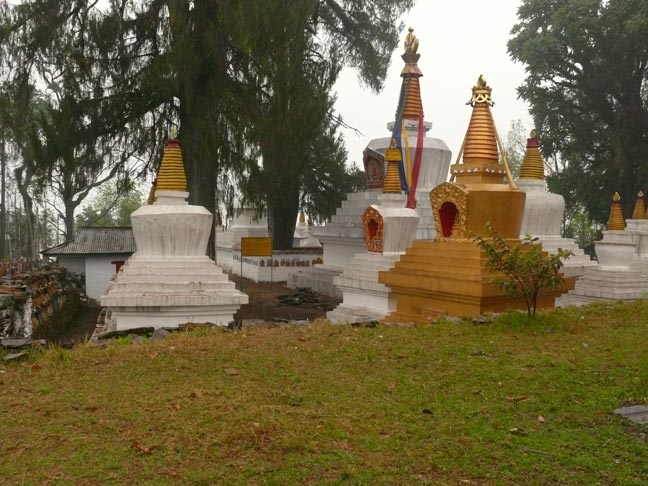
The hill on which
Tashiding is located is where Guru Padmasambhava is said to have shot an
arrow before meditating on the spot where it fell. Surrounded by chortens,
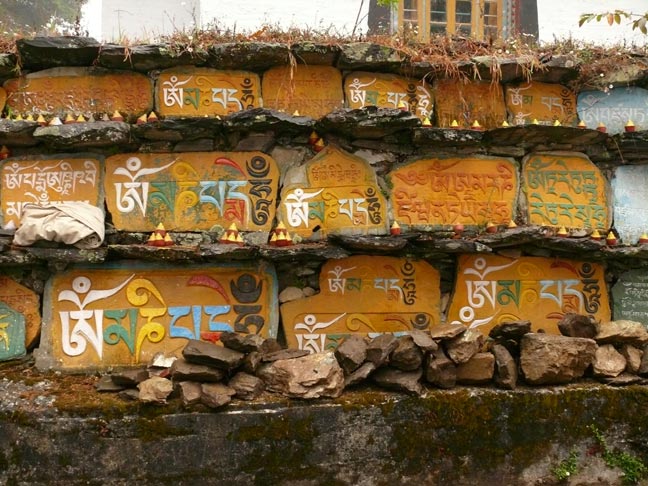
mani stones (stones with inscriptions of Om Mani Padme
Hum, hence “mani” stone), water-driven prayer wheels, and Mt. Kangchenjunga
looming behind, this is a magical spot. |
|
Large crowds gather
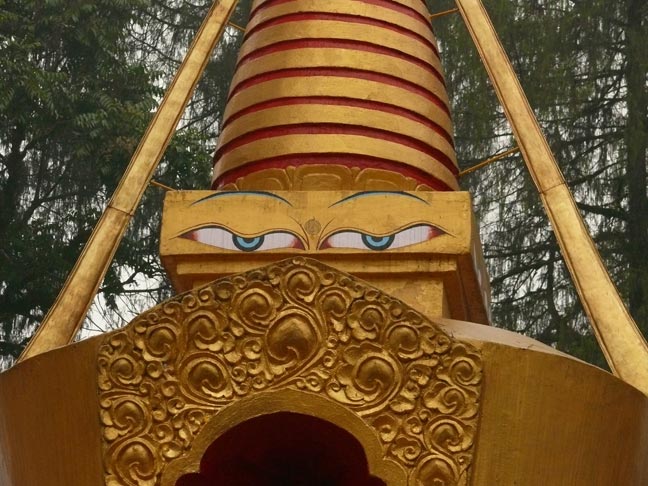
here during an annual festival. The mere sight of the Thongwa Ramgdol Chorten
is supposed to wipe away all sins. |
|
|
|
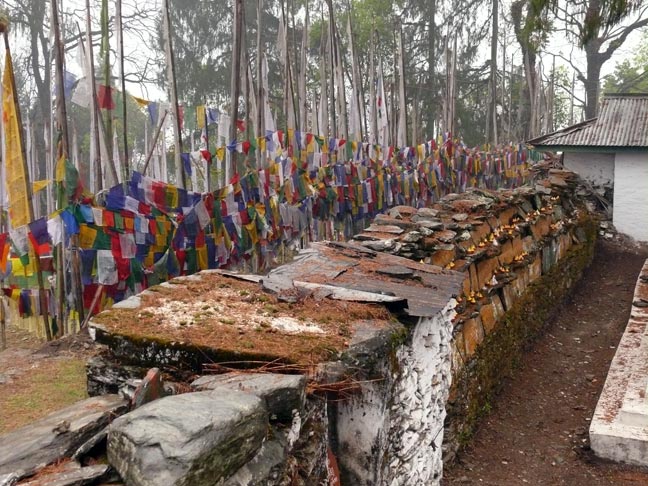
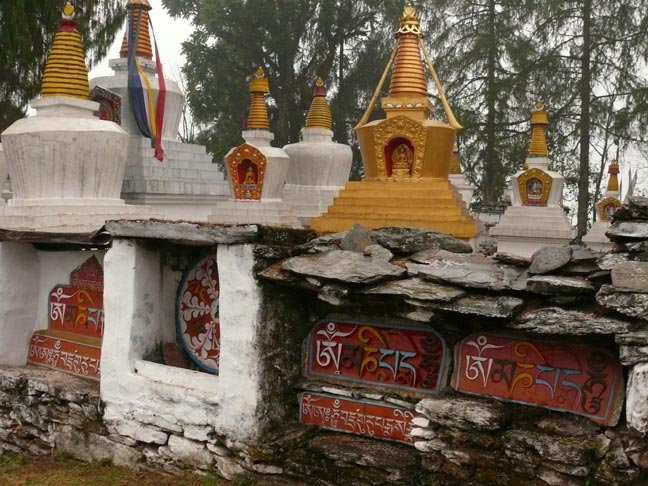
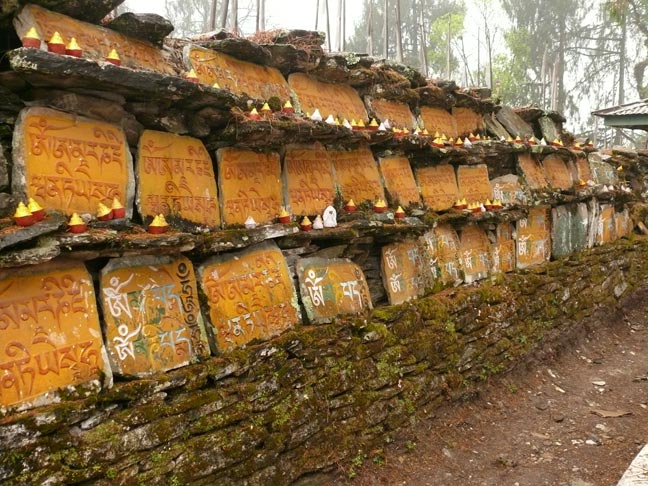
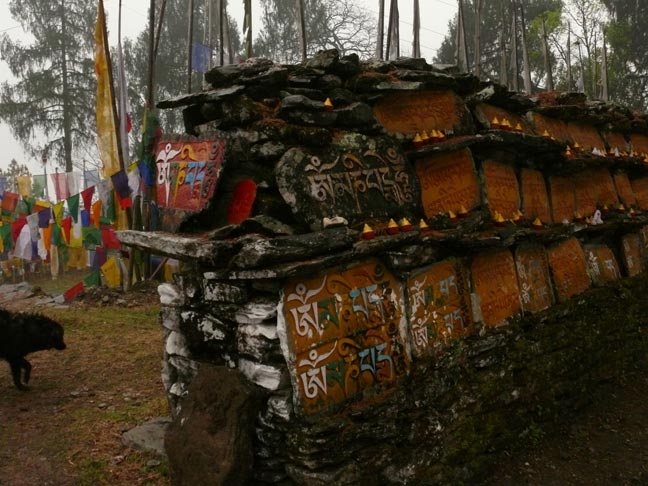
These mani walls are
stone structures with a compilation of exquisitely carved stone tablets. |
|
|
|
|
|
The mani walls should
be passed or circumambulated clockwise since, according to Buddhist doctrine,
the earth and the universe rotate that way. |
|
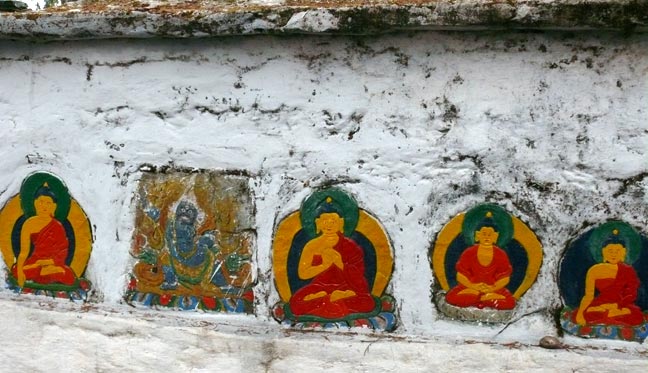
This row of Buddha
images with different mudras (ritual gestures) has one wrathful Buddha
inserted. |
|
|
|
|
|
Are YOU all you can
be? |
|
|
|
|
|
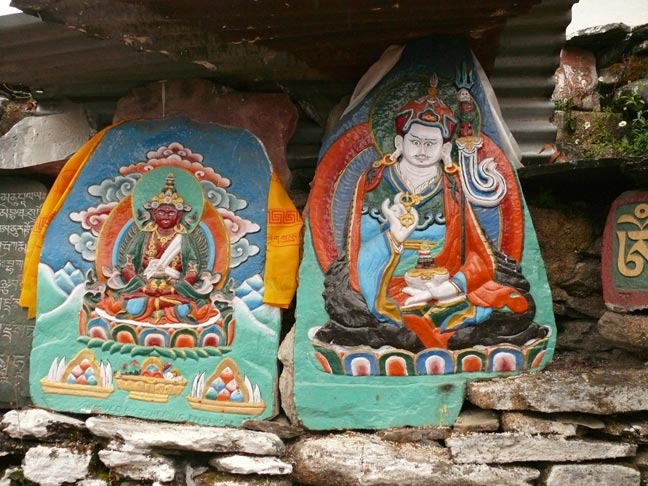
The image on the
right of this picture shows Padmasambhava holding the vajra (thunderbolt) in
his right hand. |
|
|
|
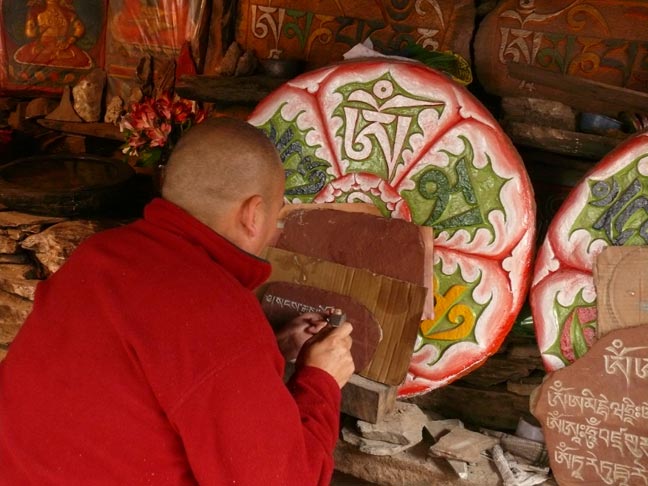
We were told that this
monk arrived here several decades ago and has been carving inscriptions ever
since. |
|
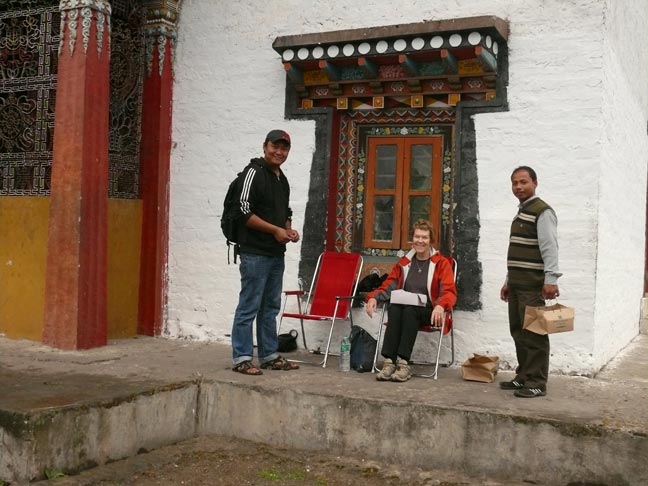
After we finished
our long visit of the Tashiding monastery we found this lunch set up. Quite a setting!
Karma and Joy made everything special – and fun. In our hotel in
Yuksom we had an interesting dinner: A dish of yak cheese
mixed with mountain fern, Chicken Sikkinese with
spinach, and green nettle soup. We enjoyed it very
much. |
|
|
|
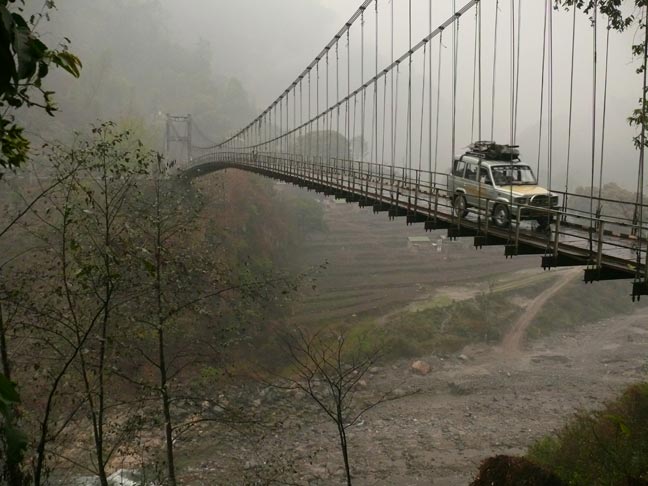
Crossing a bridge in
Sikkim. We didn’t bike that day because it rained. Sikkim has its own
“personality.” We’ve really enjoyed
getting to know the differences among the old Himalayan kingdoms,
which was a big reason we wanted to visit Sikkim. Tibet, Bhutan,
Nepal, Sikkim: their landscapes and architecture are so different. Only the
tantric religion is a constant. We hope to add
Ladakh to this list soon! (like summer 2011) |
|
Karma told us that
when he is not guiding, he helps his family harvest cardamom - a significant
export crop for Sikkim. In his village, he
showed us the new sprouts of the plant coming out of the ground. The seeds of
the plant are used for flavoring drinks, as cooking spices and in medicine. |
|

|
|
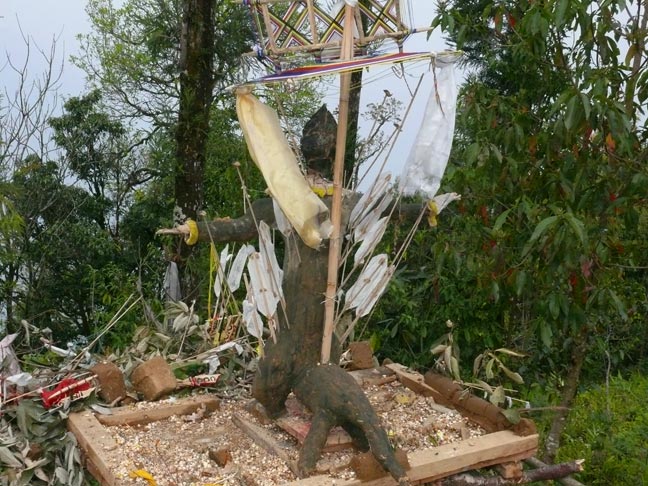
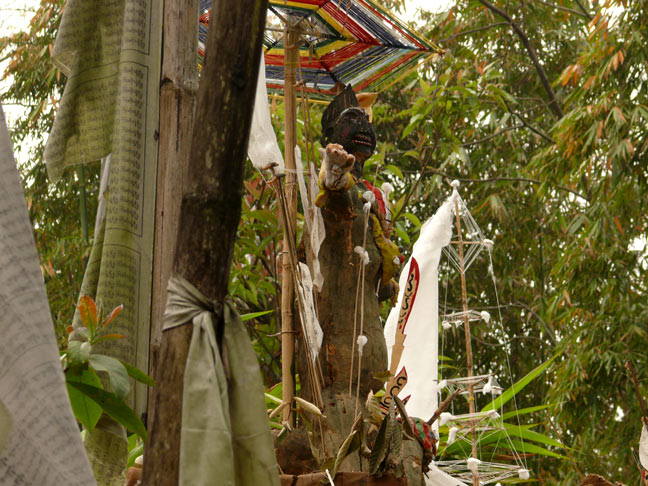
On our way to Ravangla,
we passed this fascinating site. On a platform looking over a steep hillside
was a wooden image of a female deity. There is obviously
an indigenous cult still active – which existed before Buddhism. We always
look for these experiences when we travel. This image is
created new each year and it is hoped that it will provide healthy harvests. This is a great
example of our benefiting from traveling “slow.” We were walking on the edge
of a village when we noticed it; we hadn’t seen it when we were in the car passing
by. We add extra days to
what tour programs present for more in-depth travel and are happy when it
pays off. |
|
|
|
|
|
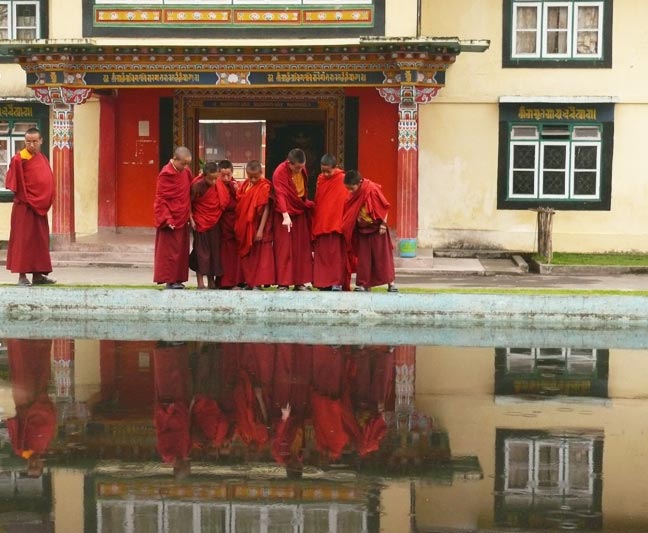
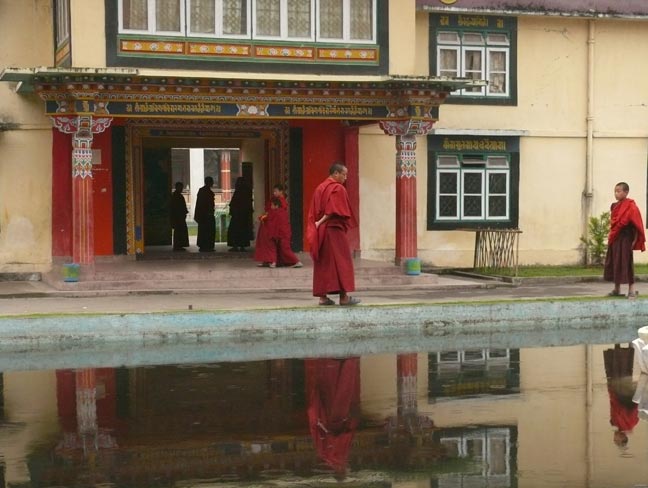
Ralang monastery near Ravangla belongs to the Kagyu order. It is host to a
festival when Mt. Kangchenjunga is worshipped. It is residence to over 100
monks. |
|
We noticed a couple of young people with 6 fingers on one
hand. Karma said it’s not un-common here! One of the “fingers” is small and
not useful. |
|
|
|
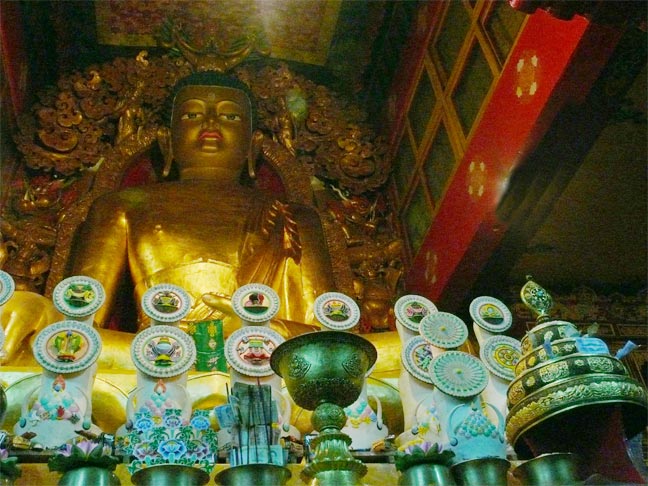
This Buddha image is inside the Ralang
monastery. The disks are offerings made of yak butter. |
|
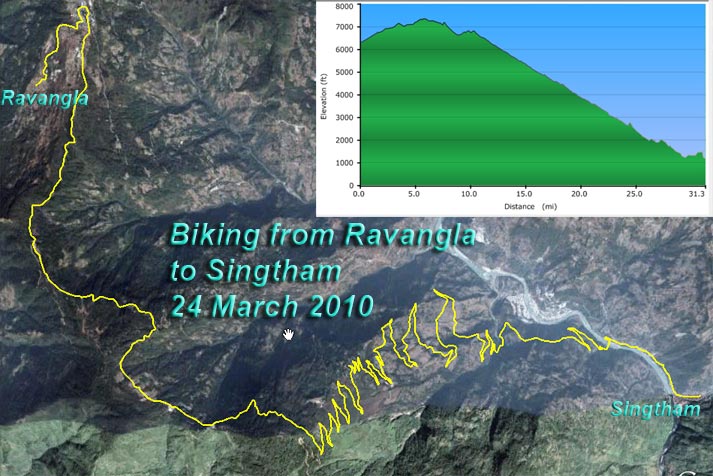
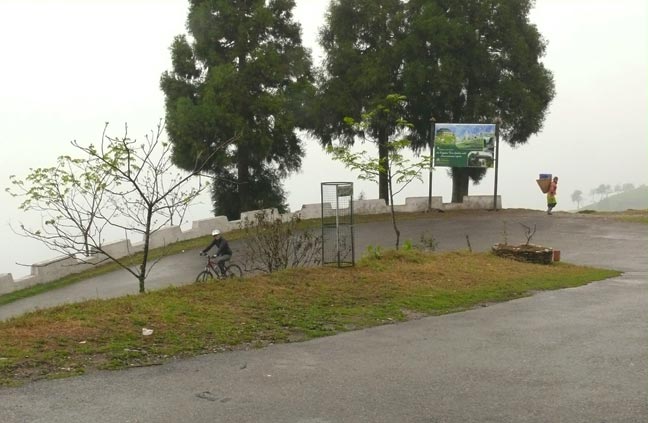
Our final biking day
was mostly a fun downhill ride but still involved over 1000 ft of vertical
climbs. Those zig zags are when we went down
through Sikkim’s only commercial tea plantation. |
|
|
|
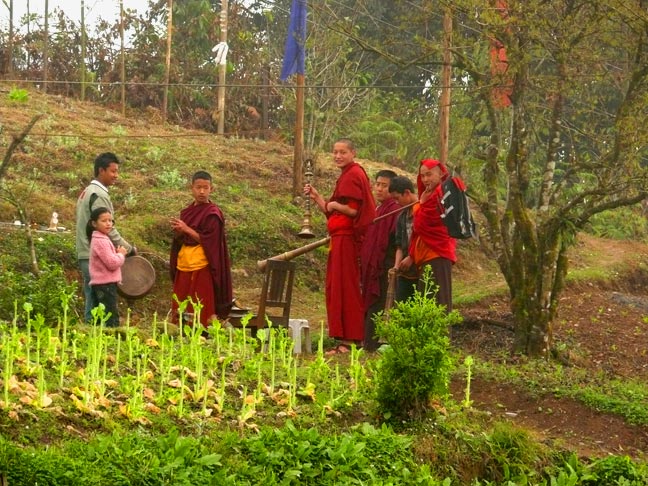
We stopped our bikes
to take a picture of a ceremony performed with music by local monks. We’ve forgotten
details, but it was for blessing a farmer’s land. In the car we
wouldn’t have seen this scene (it was a little uphill from the road) but on the
bikes we could hear the wonderful Tibetan low-pitched horn a long time before
we got there. |
|
Yvonne blasting
downhill through the tea plantation. Note the woman with the basket. |
|
|
|
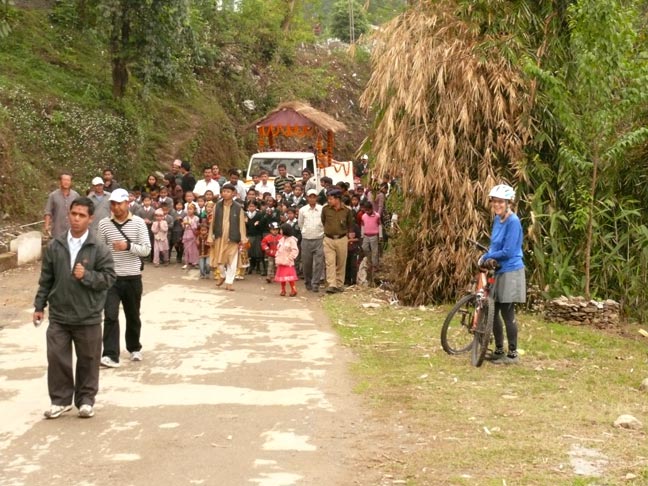
We stopped to let
this Hindu procession pass. Images from the Ramayana were enacted. |
|
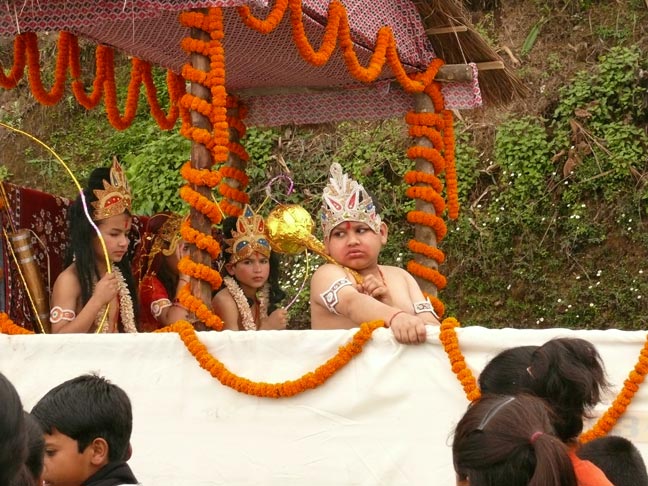
On the float were
children representing Rama, Sita and others. The Ramayana is one
of the great epics of India (the other being the Mahabharata). It tells the story
of Rama (an incarnation of Vishnu) whose wife is abducted by the demon king
Ravana of Lanka. |
|
|
|
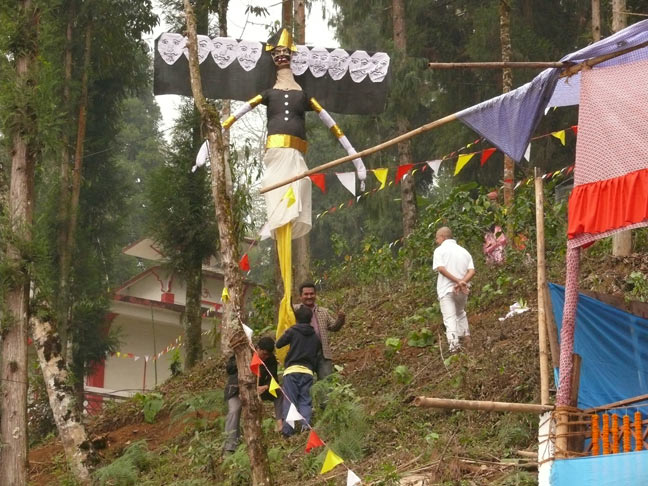
With a lot of loud
noise the effigy of Ravana was elevated on a pole to be burned later. |
|
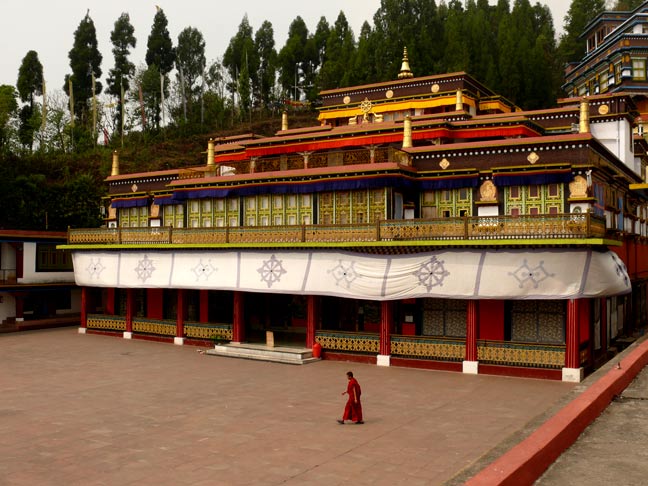
The Rumtek monastery
was built originally in the 16th c. where it served as the main
seat of the Karma Kagyu lineage in Sikkim. When the 16th Karmapa
arrived in Sikkim in 1959 after fleeing Tibet, the original monastery was in
ruins and he rebuilt it as his main seat in exile. It is now the largest
monastery in Sikkim. Two rival
organizations supporting different candidates for the 17th Karmapa
claimed stewardship of the monastery. Neither candidate resides in Rumtek. A
lengthy battle is being fought in Indian courts. Since 1992, the monastery
has been the site of pitched battles between monks supporting one candidate
or the other. Indian soldiers guard the grounds and patrol the monastery to
prevent further sectarian violence. |
|
|
|
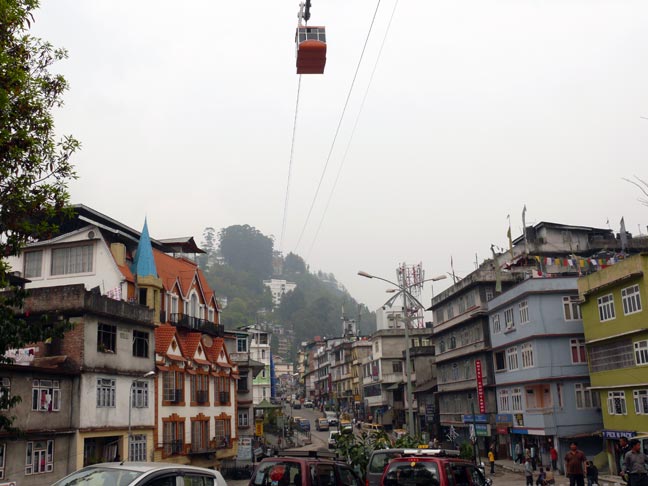
Gangtok, the capital of Sikkim, lies on a steep hill. It even has a cable car to get people from one level to
the other! |
|
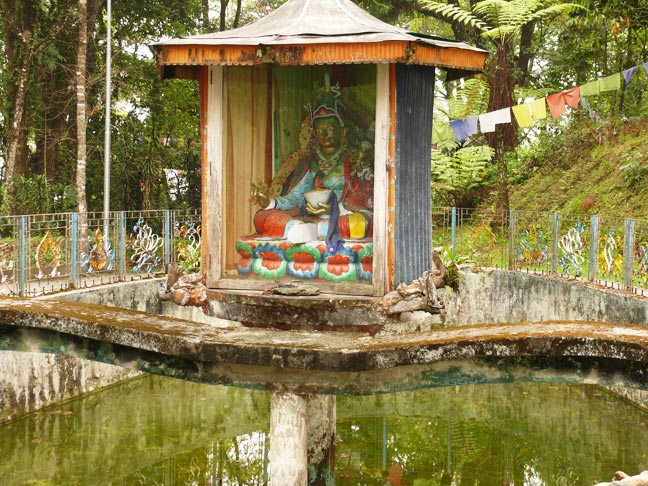
In Gangtok, we found
this shrine for Padmasambhava. This was a fitting
place to say goodbye to Sikkim. It was a wonderful
experience. |
|
|
|
|
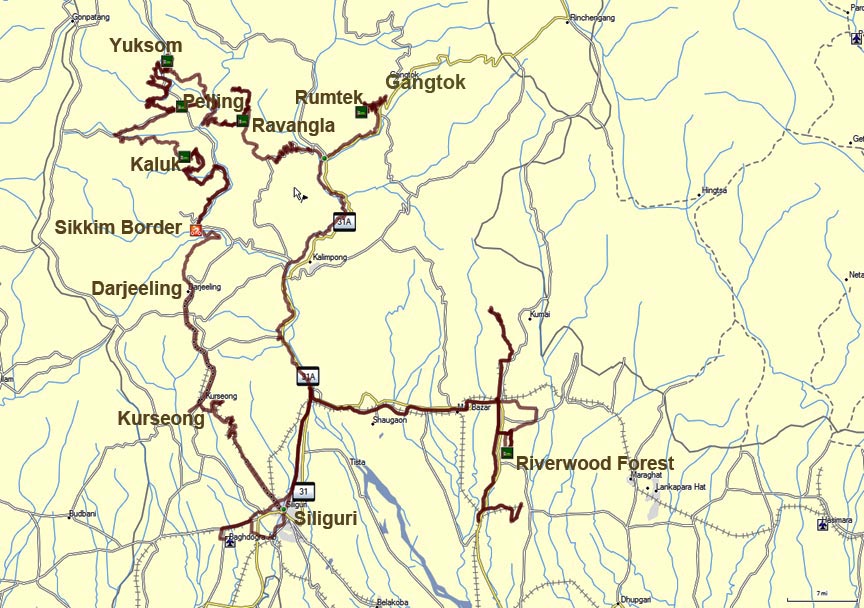
The map above
combines all of our tracks (driven and biked) for the northern part of West
Bengal and Sikkim. Prior to biking, we
wanted to spend a few days around Siliguri to get over the jetlag caused by the
12-hour time difference. Pallab set us up at
the Riverwood Forest eco-resort from where we did
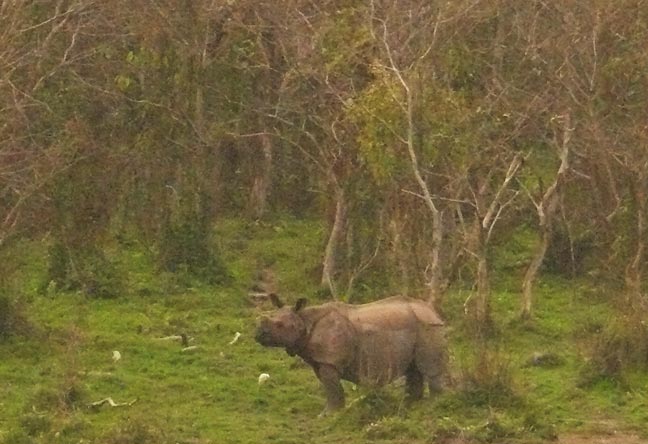
some sightseeing that included a visit to Gorumara National park. That’s where we saw
the rhino on the right. |
|
|
|
|